


"My coolest code": Bill Gates publishes source code from Altair Basic
Microsoft is celebrating its 50th birthday these days, and it all started with the Altair Basic program. Bill Gates has now published its source code.
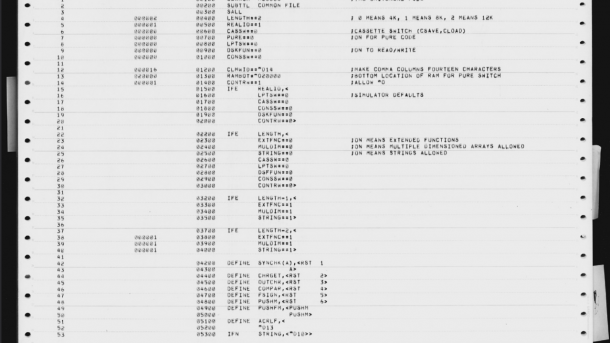
An original was scanned for publication.
(Image: gatesnotes.com)
50 years after the founding of Microsoft, Bill Gates has now published the entire source code of Altair Basic, the software that laid the foundations for the billion-dollar company. To this day, this is “the coolest code” he has ever written, writes the long-time Microsoft boss. He published it in a 157-page PDF and summarized his memories of its creation. Gates wrote the code with Monte Davidoff on an 8080 emulator programmed by Paul Allen. The delivery of the software in the summer of 1975 was the actual birth of Microsoft, which was then still called Micro-Soft – as this was the first time Gates and Allen earned their money.
The beginning of Microsoft
After hearing about the Altair 8800 in January 1975, he knew that the PC revolution was imminent and that he had to be part of it, Gates recalls. If they wrote the software for it, they could revolutionize how people interacted with those devices. Within weeks, they had written Altair Basic, adding the last few lines on the way to the device manufacturer. That's why they didn't even know whether the software would run at all, writes Gates. Nevertheless, the presentation was a success and the company MITS licensed the software. The devices with their software were delivered as early as June 1975.
Videos by heise
Gates explains that one of the biggest challenges when writing the code was the memory limitations. Because extra memory “could easily cost more than the computer itself”, they wanted to get their code into the four kilobytes it was shipped with. He used various techniques to optimize memory usage and calls it a “fun challenge”. This is another reason why it was a pleasure for him to write the code – despite the time pressure under which it was created. Gates and Allen had told MITS that the code had long been finished. He still finds the result impressive, not least because the lines ultimately led to Office, Windows 95, the Xbox, and AI.


(mho)


