


China develops its own HDMI alternative GPMI
China's GPMI connection is faster than Thunderbolt 5 and charges devices with twice the power. Huawei and other manufacturers see it as an alternative to HDMI.
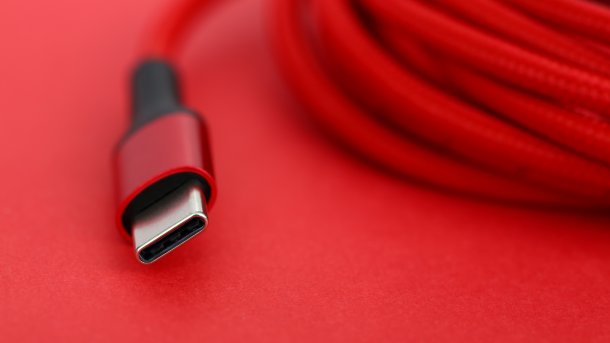
GPMI also runs via USB type C.
(Image: megaflopp/Shutterstock.com)
Apparently, a group of Chinese companies has been developing its own connection for image output since 2019. The General Purpose Media Interface (GPMI) is set to replace the High Definition Multimedia Interface (HDMI) in China. According to media reports in the Far East, the standard has now been finalized and is set to make its debut in smart TVs, among other things, later this year.
The Shenzhen 8K UHD Video Industry Cooperation Alliance (SUCA), to which 107 companies belong, including the Huawei and Tencent groups, which are represented everywhere in China, the two display manufacturers TCL and Hisense and the chip designer Hisilicon, is in charge.

(Image: SUCA / Hisilicon)
A variant with USB type C
There will be two versions of GPMI with different connectors. One of them uses the existing USB-C connector, but with its own protocol. The USB forum is said to have reserved the SVID 0xFF10 for the latter. The USB-C version transmits up to 96 Gbit/s on one side, and a connected device can also be charged with up to 240 watts. A parallel data stream achieves USB 2.0 speed at a low 480 Mbit/s. Manufacturers use the Type-C connection for compact devices such as notebooks.
Thunderbolt 5 and USB4 version 2.0 with bidirectional 80 Gbit/s are already faster than GPMI type C via the same connection. Asymmetrically, Thunderbolt 5 and USB4 version 2.0 achieve 120 and 40 Gbit/s respectively, for example for screens with 8K resolution. Both are also designed for charging capacities of up to 240 watts.
| Standard | Transfer rate | Power supply |
| HDMI 2.0 alias 2.1 TMDS | 18 Gbit/s | - |
| HDMI 2.1 FRL (Fixed Rate Link) | 48 Gbit/s | - |
| DisplayPort 2.1 (UHBR20) | 80 Gbit/s | 240 watts |
| Thunderbolt 4 / USB4 | 40 Gbit/s bidirectional (80 in total) | 100 watts |
| Thunderbolt 5 / USB4 Version 2.0 | 80 Gbit/s bidirectional (160 in total) |
240 watts |
| GPMI Typ C | 96 Gbit/s | 240 watts |
| GPMI Typ B | 192 Gbit/s | 480 watts |
GPMI Type B outperforms them all
GPMI type B is more exciting with a new connection that resembles a flatter HDMI port and is intended for larger devices such as monitors, televisions and desktop PCs. Here, 192 Gbit/s on one side and a charging power of up to 480 watts are possible. The 192 Gbit/s are distributed over eight links in the cable, the direction of which can be switched as required. For example, 96 Gbit/s would be possible in both directions simultaneously. There is also a separate USB 2.0 stream here. HDMI 2.1 and Displayport 2.1 are significantly slower and have no charging option.
Videos by heise
Both GPMI variants also integrate a so-called Cableinfo Link (CL) as an alternative to HDMI-CEC (Consumer Electronics Control). This should allow various devices on a smart TV to be controlled via a single remote control. Also included is an alternative to High-bandwidth Digital Content Protection (HDCP) called ADCP.
GPMI presented the SUCA at the end of 2024. Hisilicon provides a white paper. The websites ITHome and HKEPC, among others, recently reported on the presentation.
Empfohlener redaktioneller Inhalt
Mit Ihrer Zustimmung wird hier ein externer Preisvergleich (heise Preisvergleich) geladen.
Ich bin damit einverstanden, dass mir externe Inhalte angezeigt werden. Damit können personenbezogene Daten an Drittplattformen (heise Preisvergleich) übermittelt werden. Mehr dazu in unserer Datenschutzerklärung.


(mma)


