


Forecasting machine: How AI is set to improve rail travel information
In long-distance transport, Deutsche Bahn plans using AI to report a stop failure 60 minutes in advance. Abrupt increases during stops are to be avoided.
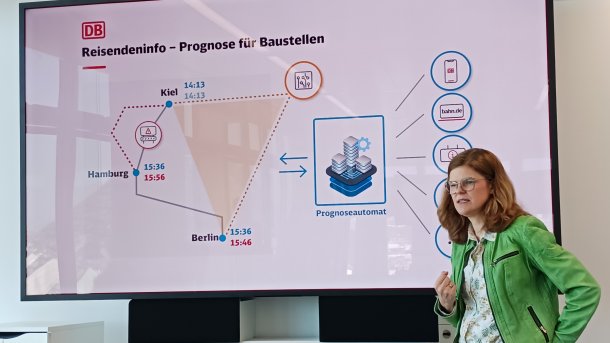
Daniela Gerd tom Markotten in front of a graphic showing how the new forecasts work.
(Image: Krempl)
Deutsche Bahn (DB) wants to significantly improve the quality of travel information via all playout points such as the DB Navigator, monitors at stations and displays on trains. For example, stop cancellations on long-distance services are to be communicated at least 60 minutes in advance instead of the current eleven minutes. Sudden increases in unscheduled stops should occur less frequently. Deutsche Bahn intends to update this information every two minutes.
Overall, forecasts for train arrivals and departures are to become more accurate as part of the S3 refurbishment programme, explained Daniela Gerd tom Markotten, Head of Digitalization and Technology at DB AG. According to her, the information for travelers will be more reliable, consistent, understandable, intuitive “and therefore action-guiding”. Artificial intelligence (AI) plays an important role in this. Deutsche Bahn has turned its 40,000 trains a day into around 400 million data points, Markotten explained. This results in around 150 million forecasts for over 20,000 regional and long-distance journeys every day.
According to the manager, DB uses pattern recognition, machine learning and reinforcement learning to make these predictions. This “reinforcing” method mimics the learning process that humans use to achieve goals through trial and error. The AI system, which has been set up since 2018 and uses many open libraries and algorithms as defined by the OpenRail Association for the development of open-source software projects in the rail sector, looks at how the train routes compared to actual journeys and what the customer and operating timetables look like. The actual GPS real-time data from the trains and insights into the regular travel volume are also included.
“Single point of truth” data platform
The resulting automatic forecasting system already factors in the 20-minute delay caused by known roadworks, such as a current detour between Hamburg and Kiel. If something else happens on the rest of the route to Berlin, for example, the system adds another ten minutes. However, if there is also a point's fault, the machine “reaches its limits”, admitted Markotten. In addition, dispatchers from the DB infrastructure company InfraGo and regional railroad companies can now also manually enter their more precise forecasts into the system in consultation with the responsible train driver. This means that the machine now works “very, very well in principle”.
As “fuel for the AI”, DB is constantly integrating new data sources such as capacity utilization displays. These are now also provided in real time for each carriage, so that passengers can position themselves appropriately on platforms. The aim is to display information in the same quality and time on all output channels. To this end, Deutsche Bahn has built a common data platform (“single point of truth”). However, there are still technical delays, which can be a few seconds for station monitors and a little longer for the navigator. Some of the oldest ICE trains from the early 1990s lack the technology for real-time displays.
Upgrading monitors
In 2024, Deutsche Bahn has also installed over 1,650 modern and higher-resolution monitors on platforms nationwide for almost 50 million euros from the federal and state governments and DB. These are so-called dynamic text displays (DSA), which are used at smaller stations, as well as large train information monitors (ZIM) at medium-sized and large stations. At Berlin Central Station, for example, travelers can now view the displays on six 200-inch monitors, split into regional, long-distance and S-Bahn services. The hardware used here and at other large hubs is the “Passenger Information of the Future” (IRIS+), which also provides a colored background for synchronous changes. The forecast accuracy of train and stop failures as well as track changes is to increase from the current 74 percent to 80 percent by 2027 at the latest.
Videos by heise
Germany ticket better considered in the Navigator
The Navigator, which Stefanie Berk, Head of Marketing at DB Fernverkehr, described as a “beacon” with over 80 million downloads, around 35 million customer accounts and 160 million travel information requests per month, has had two new functions since March. In the connection overview, a filter can be used to display only connections that can be used with the Deutschlandticket. When booking a ticket with long-distance trains, any local transport components are no longer included in the calculation. The “Travel preview” function is now also available on the Smartwatch (iOS and Android).
Alternative services are now stored in the app with roadworks information and an interactive map. DB and two or three other companies are testing the transfer of data according to the new Open Sales and Distribution Model (OSDM) standard for booking international journeys. From the middle of the year, Deutsche Bahn also wants to go live with the sale of tickets “from outside”. The company attaches great importance to data protection in the app so that it is relaxed about the lawsuit filed by Digitalcourage activists regarding tracking.


(mma)


