


Open source robot helps develop new materials
A robot made from a 3D printer and commercially available components can help to create new materials. The robot is open source.
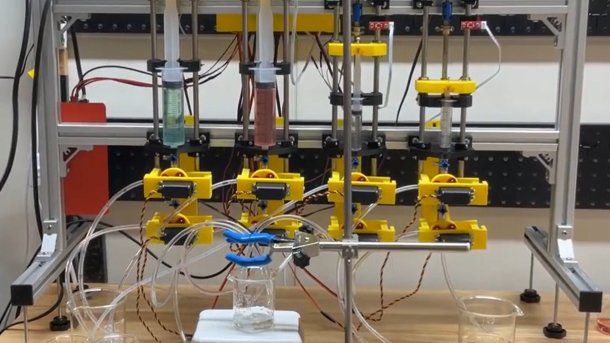
The FLUID robot can be used for material development.
(Image: Keisuke Takahashi)
A research team from the Faculty of Science at Hokkaido University has developed a robotic system called FLUID (Flowing Liquid Utilizing Interactive Device) from a 3D printer and other commercially available electronic components that can help create new materials. The robot is open source and can be freely reproduced for your projects in materials science.
FLUID essentially consists of four independent modules that are based on a conventional 3D printer. The individual modules each comprise a syringe, two valves, a servo motor for valve control and a stepper motor for precise control of the syringe plunger. The modules are equipped with an end-stop sensor to monitor the fill level of the syringe. The modules are controlled via microcontrollers that receive their control commands from a computer via USB. Sensors provide status information, such as valve settings and syringe movements, in real time so that this data can be considered in the control processes.
“By adopting open source, using a 3D printer and utilizing commonly available electronics, it was possible to design a functional robot that is customized to specific needs at a fraction of the cost typically associated with commercially available robots,” says Mikael Kuwahara, lead author of the study “Development of an Open-Source 3D-Printed Material Synthesis Robot FLUID: Hardware and Software Blueprints for Accessible Automation in Materials Science,” published in ACS Applied Engineering Materials.
FLUID enables materials scientists to develop new materials faster. The robot can be used to automate the coprecipitation process. Normally, soluble substances are removed by a precipitate. In materials science, this process is used to produce nanoparticles or synthesize lanthanide-doped nanocrystals, for example.
Inexpensive robot also for niche applications
The scientists are making the instructions for building the robot available as open source (download). They aim to provide a broad research community with a low-cost robot that can automatically carry out experiments in materials science. This is particularly advantageous in niche areas for which no commercial systems are available or are simply too expensive.
Videos by heise
However, the development of FLUID is not yet complete, say the researchers. They want to install further sensors to monitor temperature and pH value, for example, and incorporate them into the processes. The robot should thus be able to handle a wider range of chemical reactions. These include polymer mixing and organic synthesis.
The scientists also want to make further improvements to the control software. They intend to add macros for repetitive tasks and want to improve data logging.



(olb)

