


Researchers develop 3D holograms you can touch and move
A 3D hologram you can touch and move: Spanish researchers have created something that is usually only seen in science fiction films.
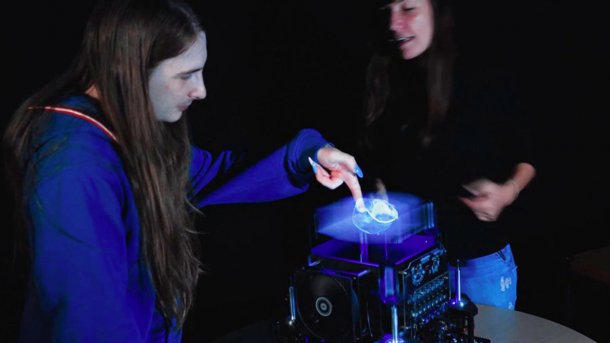
A UPNA researcher reaches into the eye socket of a projected 3D skull.
(Image: Iñigo Ezcurdia)
A Spanish scientific team from the Public University of Navarra (UPNA) has succeeded in developing a volumetric display for 3D graphics that can be touched and moved while suspended in the air. The FlexiVol display can be used wherever visual and haptic experiences need to be combined.
Classic 3D holograms are actually true 3D graphics, volumetric representations of graphics that float in the air and can be viewed from different angles. Virtual reality (VR) glasses do not need to be worn to view them. Although such volumetric displays are already available from companies such as Voxon Photonics and Brightvox, they can only project images and cannot be interacted with. The UPNA researchers, on the other hand, have been looking for a way to grip and move such 3D projections so that they can be interacted with.
"We are used to interacting directly with our phones by tapping a button or dragging a document directly onto the screen with our finger, which is natural and intuitive for humans. This project allows us to use this natural interaction with 3D graphics to exploit our innate abilities of 3D vision and manipulation", explains Asier Marzo, head of the research project.
The scientists have summarized their findings in the study "FlexiVol: a Volumetric Display with an Elastic Diffuser to Enable Reach-Through Interaction", which has been published in HAL science ouverte.
Volumetric displays project images onto a fast-moving surface, the diffuser. This oscillates 2880 times per second. Due to the inertia of the human eye, the layered image is perceived as a complete 3D object floating in the air. However, the diffuser is rigid. If you tried to touch it, you could destroy it or damage your fingers.
Haptic experience thanks to soft diffuser
The UPNA scientists replaced the rigid diffuser plate with a softer material. This proved to be tricky, as the material also influences the visual display. At the same time, however, the material has to be strong enough to allow a sufficient haptic feel. The researchers found that the deformable material they used made it necessary to incorporate an image correction so that the projected image did not change when touched.
Videos by heise
As a first step, the scientists projected a 3D cube in the air that can be touched and moved. Users can also walk on a surface of the cube using their index and ring fingers as legs. This also works if several people are handling the 3D hologram at the same time. This type of display can therefore also be used for collaborative work.
According to the UPNA science team, the possible applications are diverse: it could be used at work, for entertainment and in education. Users are not just in their own world, as is the case when using VR glasses, but can interact with virtual 3D objects together.



(olb)

