


Autonomous drone beats human drone world champion in race for the first time
An autonomous drone flies through a championship course faster than a human. This is made possible by an AI that uses space technology.
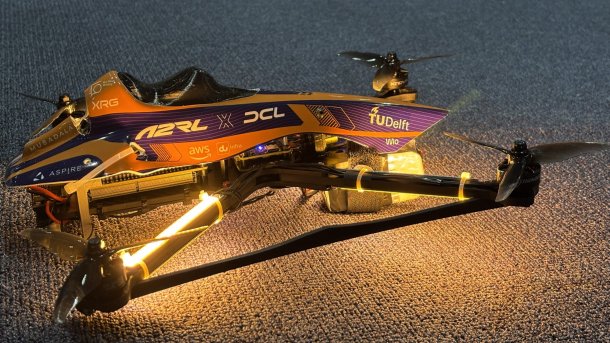
The autonomously flying winning drone from Delft University of Technology reached speeds of up to 95.8 km/h on the competition course.
(Image: Delft University of Technology)
An autonomous drone equipped with artificial intelligence (AI) developed by Delft University of Technology has beaten drones controlled by human pilots for the first time in an international drone competition. In the final, the AI drone flew faster through the very winding course than three former DCL (Drone Champions League) world champions.
The victory of the AI drone took place on April 14, 2025, as part of two championships for AI-controlled, autonomous drones, the A2RL Drone Championship and the Falcon Cup Finals for human drone pilots. Following both championships, the organizers pitted the best human drone pilots against the best AI drones.
The autonomous drone from Delft University of Technology won the A2RL Grand Challenge and also prevailed in the mixed competition. The drone won the knockout tournament, beating three former DCL world champions on a challenging winding course. The autonomous drone reached speeds of up to 95.8 km/h.
An AI drone from the Perception Group at the University of Zurich had already beaten human championship pilots in a drone race in 2023. However, the flights were carried out under controlled laboratory conditions at the time. The hardware and route were determined by the researchers. At the race in Abu Dhabi, on the other hand, the organizers determined the hardware and the route to be flown.
The first victory of an AI against human pilots in an official competition is roughly equivalent to the first victory of a chess computer against a human player – with the only difference being that the autonomous drone uses physical intelligence.
With technology from space travel
The winning drone's AI was developed by a team of scientists and students from the MAVLab at the Faculty of Aerospace Engineering in Delft. The drone was only allowed to use a forward-facing camera to perceive its surroundings. This was probably to ensure equality of opportunity with human drone pilots, who also only control their drones with a forward view.
Empfohlener redaktioneller Inhalt
Mit Ihrer Zustimmung wird hier ein externes YouTube-Video (Google Ireland Limited) geladen.
Ich bin damit einverstanden, dass mir externe Inhalte angezeigt werden. Damit können personenbezogene Daten an Drittplattformen (Google Ireland Limited) übermittelt werden. Mehr dazu in unserer Datenschutzerklärung.
The development team drew on technology from the European Space Agency (ESA), which was developed by the Advanced Concepts Team under the name Guidance and Control. This uses a deep neural network that sends its control commands directly to the drone's motors rather than via a controller.
Videos by heise
Normally, optimal control algorithms for autonomous drones require immense computing power, which cannot be realized on board the drone with its limited computing power and energy. ESA discovered that this problem can be avoided with the help of neural networks. These can imitate control algorithms, but require significantly less computing power. However, ESA was unable to test the technology, which was actually developed for satellites, in space and therefore agreed to cooperate with the MAVLab, which it uses in its autonomous drones.
The deep neural networks are trained using reinforcement learning (– RL) via trial and error. Strategies that work are rewarded, others are punished. This brings the AI closer and closer to the physical limits of the drone. “To achieve this, however, we not only had to redesign the training procedure for the control system, but also the way in which we can learn about the dynamics of the drone itself from the sensor data,” says Christophe De Wagner, team leader of the project.
However, racing drones are not the only use case for fast autonomous drones. The improvement of autonomous technology plays a role wherever drones have to be used in a time-critical manner, such as for the delivery of medicines and defibrillators, as well as for locating people in disaster areas.



(olb)

