


"Oblivion Remastered" also shows the ugly side of the Unreal Engine
The Unreal Engine makes “Oblivion”prettier than ever, but also brings with it a performance burden. Due to technical shortcomings on the PC, it's better to wait.
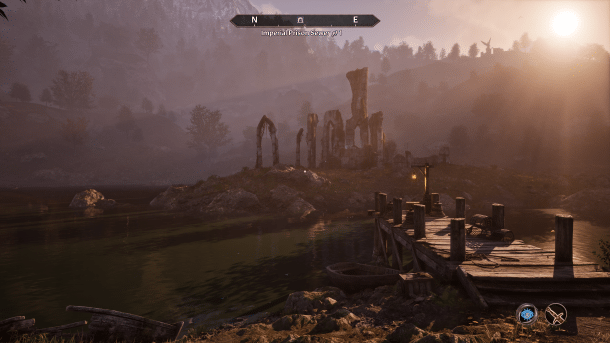
THE "Oblivion" moment: bittersweet, because the performance suddenly breaks down here.
(Image: heise online)
The moment when you leave the sewage system of the imperial prison complex in “Oblivion” and step out into the open game world for the first time is gaming heritage. In the remastered version, this sight is prettier than ever – if you can get that far. For many PC gamers, the game reliably crashes in the loading screen that precedes it.
But even if you get through the loading screen, the actually breathtaking view is significantly dampened: the previously solid performance indoors in the open game world of the “Oblivion Remastered” goes completely down the drain. As is so often the case with the modern Unreal Engine: you have to take the good with the bad. And with “Oblivion Remastered”, the bad still outweighs the good. Above all: stutters, even on a high-end system with RTX 5080 and Ryzen 7 7800X3D in 4K resolution. We have not yet tried out the console versions.
Unreal problem zones
Thanks to the remaster's extensive graphics settings, it will generally be possible for many PC systems to achieve a playable frame rate: DLSS, FSR and XeSS scale up low resolutions to save performance, and if in doubt you can still boost the FPS with Frame Generation. But none of this helps much if a game can't get its stuttering under control. Unfortunately, this is the case with “Oblivion Remastered”: Even at high frame rates beyond 100 FPS, the game feels choppy and just overall unfluid because the frame pacing is unstable. This means that the images are not delivered smoothly. In addition, there are larger, particularly noticeable jerks when you move the character or the camera.

(Image: heise online)
When you start “Oblivion Remastered” for the first time, you are greeted with a loading screen for shader compilation. This is annoying, but actually makes a lot of sense: if the shaders are compiled in advance, this step can be omitted during gameplay. The typical shader compilation jerks that would then occur during gameplay are thus eliminated. At least in theory.
In practice, despite initial shader compilation, many Unreal Engine games also suffer from stutters during gameplay when new effects are shown on the screen for the first time. In addition, the games often stutter when you simply move from A to B. All of this has severely damaged the reputation of the Unreal Engine in the gaming community.“Oblivion Remastered” relentlessly exposes these problem areas.
Videos by heise
Two graphics pranksters
The tricky thing about Unreal Engine jerks is that you often can't get them completely under control with graphics settings. You have to put up with them. However, there are a few adjustments you can make to improve the performance in “Oblivion Remastered”: In particular, the setting for hardware lumens, the Unreal Engine form of ray tracing, eats into performance. “Oblivion Remastered” does not work completely without Lumen, but the software version runs much more efficiently – with corresponding visual losses.


(Image: heise online)
Bethesda's own Gamebryo/Creation Engine still runs under the Unreal Engine in "Oblivion Remastered". Officially, Bethesda does not offer modding support. However, the modding community has already found ways to change content anyway: There are already the first modifications on Nexusmods that change the color of armor, for example. Modding veterans give the remaster a good report and expect extensive modding options.
However, the familiar console commands from the "Elder Scrolls" games do not work properly in the remastered version: "tcl" is accepted, but does not actually switch off the collision. Commands to hide the user interface also do not currently work. Instead, you can experiment with commands from the Unreal Engine environment. The developer console can be opened with the "#" button on the keyboard.
The implementation of motion blur in “Oblivion Remastered” shows artifacts and should therefore be switched off completely. The Screen Space Reflections option also makes water reflections uglier rather than prettier. The remaining settings can be adjusted according to personal preferences, tolerances, and performance goals. The most important lever is upscaling via DLSS, XeSS or FSR, which can significantly improve the frame rate.
"Oblivion Remastered": Motion Blur und Screen Space Reflections (3 Bilder)

heise online
)It doesn't get any smoother
Ultimately, we couldn't get “Oblivion Remastered” to run completely smoothly even on minimum settings – You just can't get rid of the stuttering. Otherwise, the role-playing game still makes a technically half-baked impression: loading screens tend to freeze, even the soundtrack stops before continuing. And when switching to the game menu, waiting times sometimes last for seconds.

(Image: heise online)
So let's hope that Bethesda and the game studio Virtuos will get the performance quirks of “Oblivion Remastered” under control in the coming weeks. The graphics card manufacturers could also make improvements with drivers, for example. We wouldn't want to play the role-playing game in its current state.
"Oblivion Remastered": Minimale vs maximale Einstellungen (2 Bilder)

heise online
)That's a shame because apart from the technical flaws, the remaster makes an excellent impression: the new creature designs are outstanding, the new melee combat system is powerful and really fun, magic effects are a feast for the eyes. Among all the new features, the “Oblivion” identity remains unquestionably intact: Bethesda has retained the exquisitely messed-up NPC dialogs in the remaster, and the character editor can once again produce incomparable horror creatures if desired. The grandiose charm of “Oblivion” is retained in the remaster, and the gameplay improvements are brilliant. So it might be worth waiting for patches that will hopefully remove a few technical barriers.


(dahe)


