


25 years of "The Legend of Zelda: Majora's Mask": dark time game
Having to follow a work of the century is a highly thankless task – which "Majora's Mask" mastered with flying colors 25 years ago.

(Image: Nintendo)
"The Legend of Zelda" is without question one of the most important game series of all time: The first part, first released in spring 1986 on Nintendo's short-lived "Famicom Disk System", defined the action-adventure game as we know it today. The third part, "A Link to the Past" (1991), gave SNES players a gigantically large and, above all, gigantically varied game world.
And then came the year 1998, and with it, shortly before its end, the official fifth part of the series, subtitled "Ocarina of Time". Which, as luck would have it, is still the highest-rated game of all time on the Metacritic rating aggregator, with an average score of 99 out of 100. A milestone, a monument, an eternal classic that brought the series into the 3D world for the first time, and on this occasion defined action-adventure standards that are still valid today – such as target acquisition in 3D space or context-dependent actions, all of which were on one button.
"The Legend of Zelda: Majora's Mask" wird 25 (12 Bilder)
heise online
)How could such a monumental success ever be continued in a manner befitting its status? Eiji Aonuma, one of the directors of "Ocarina of Time", who was primarily responsible for the design of the dungeons and temples, was supposed to answer this question. Actually, there was only supposed to be a "Ura" version of "Ocarina of Time" (a director's cut, so to speak) for the N64 disk system "64DD" on the N64. However, Aonuma wanted to do more than just expand the familiar dungeons a little, and after some prodding he received permission from Miyamoto to create a new Zelda game using the 3D assets already created for "Ocarina of Time". The condition: it could not take more than a year. In the end, this did not work out, and the development of "The Legend of Zelda: Majora's Mask" took around 15 months. But in view of the result, this can still be considered a miracle.
Finnish death metal: the game
The result, released in Japan on April 27, 2000 (North America and Europe were October and November respectively), followed in the footsteps of its predecessor at first glance: the interface was identical, the 3D graphics only improved in details, there was various whistling on the Ocarina of Time, a slightly annoying light fairy and four massive dungeons to explore – Connoisseurs of the predecessor immediately felt welcome. And then quickly realized that the new parallel world "Termina" was more than just a repainting of the classic Zelda scenario "Hyrule". After all, "Ocarina of Time" already had its dark moments. But no comparison to the drama that was played out in "Majora's Mask".

Because the entire game revolves around loss and destruction. The destruction of the entire world, to be precise: Termina is doomed by the misdeeds of the so-called "Horror Kid" (whom Link meets directly in the intro), in exactly three days the moon will crash down on the world and destroy everything and everyone in a gigantic explosion. A sword of Damocles that hangs constantly over Link's head – or rather underneath it, as there is a clock at the bottom of the screen that ticks down without pause or mercy. In the real world, the 72 available rescue hours take a little less than an hour. What can you do in this very limited time?
Well, a lot of the same things you did in "Ocarina of Time": Fighting (albeit significantly less than before), solving puzzles, completing tasks. Unlike in its predecessor, however, in "Majora's Mask" there is no way to be there for all the NPCs and their numerous side missions within the time limit. Link clearly has to prioritize if he doesn't want to have a front row seat to see Termina go down in a sequence that is as impressive as it is fiery.
The gift of time
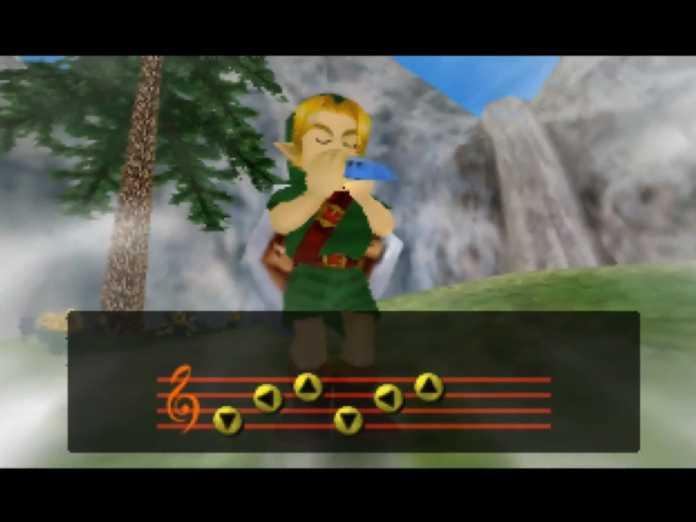
Link's most important task is therefore to prevent the fall of the diabolically grinning, red-eyed terror moon, and once again the Ocarina of Time plays an important role. This is because he learns various songs on it over the course of the adventure, including the "Hymn of Time" and the "Ballad of Kronos", with which he can turn back time three days or slow it down to a third of the speed.
The former melody is a crucial element of the game, as cranking the clock back to the day before yesterday is unavoidable for normal players. If you flute the melody of time and travel back three days, you lose most of your possessions and the progress you have made in that round, but keep your experience, masks, weapons and life energy. The game has thus anticipated an important element of modern roguelikes. Playing through the 72 hours of the game multiple times is therefore the most important Zelda player duty. Little by little, time leap by time leap, Link restores order in Termina, talks to more people, gains important experience – and gradually acquires the tools that make a happy ending possible in the first place.
One of the most important tools on this difficult path is the mask. Or rather the masks, as there are 24 of them in total, most of which are just bonus stuff: there is one that helps Link to track down the 15 fairies in each of the four temples. Another (with rabbit ears!) lets him run faster, and a third is needed to round up chicks.
However, three are essential for the course of the game: the first transforms Link into a "Deku child", a tree creature – a form in which he can fly for a short time and walk on water, among other things. With the Goron Mask, Link becomes a powerful stone fighter who can also destroy massive obstacles and roll over lava lakes. And in "Zora" form, he becomes a master swimmer who can, among other things, walk along the seabed and throw boomerang fins around. Masks also existed in "Ocarina of Time", but not in such a sophisticated, game-changing form as here.
Videos by heise
Time is something fleeting and fast...
"Majora's Mask" therefore went to great lengths to stand out as clearly as possible from the overwhelming shadow of its predecessor. Something that the gaming press at the time also knew how to appreciate: the game received top marks across the board, and today has a Metacritic average of 95 points. A little less than "Ocarina of Time", but still without question a sensational achievement.
Just like its commercial success, as "Majora's Mask" sold a total of almost 3.5 million copies on the N64. However, it was once again beaten by its predecessor, which sold almost twice as many copies – but was also significantly more expensive to develop. At the beginning of 2015, the game was then released on Nintendo's 3DS handheld in a remastered version, and since 2022, the original version has also been part of the N64 emulation offering in the Nintendo Switch Online service.
And even 25 years after its original release, it is still worth picking up this dark gem: "Majora's Mask" may not be the great classic that its direct predecessor was, but it is still an excellent adventure that more than lives up to the great series name. Unlike other parts of the series, this one doesn't involve fighting against the big bad. Instead, in "Majora's Mask", as in real life, time is the real enemy. You can't escape it, you can't defeat it – you can only make the best of it. A beautiful lesson.


(dmk)

