


Hugging Face reveals construction plans for 100-dollar AI robot arm
Hugging Face has revised its SO-100 robot arm and released the improved version SO-101. Instructions for building it are available on GitHub.
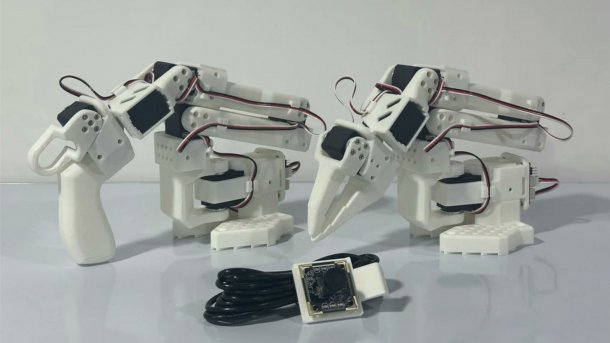
The SO-101 robotic arm from Hugging Face can be trained using reinforcement learning.
(Image: Hugging Face)
The US AI company Hugging Face, together with the French robotics company The Robot Studio, has developed the SO-101 robotic arm, which can be trained using reinforcement learning (RL) and can therefore perform simple tasks independently. The construction plans for the robotic arm are available on GitHub for replication. It starts at a price of 100 US dollars. However, better equipped and pre-assembled versions can cost up to 500 dollars.
The SO-101 is the successor to the already available SO-100 and comes with a range of improved and more powerful components. These include enhanced servo motors that enable the robot to lift and move objects up to the robot arm's own weight. The SO-101 should also be easier and faster to assemble.
The parts and kits are supplied by the robotics store WowoRobo, the IoT hardware provider Seed Studio and PartaBot, a store that offers robotics parts. The entry-level model with all the necessary components costs from 100 dollars. Prices are higher depending on the equipment and whether the robot arm should be pre-assembled. The country of import also plays a role: due to higher customs duties, users in the USA have to pay more for components from China than hobbyists in Europe, for example.
Construction plans on GitHub
If you like, you can also obtain the parts for free and print out the structural components yourself using a 3D printer. Hugging Face provides instructions for this on GitHub, which include a list of the required parts and tips for printing with various 3D printers and assembly.
Videos by heise
A finished SO-101 robotic arm can then be trained using RL. For example, the robot can learn to sort different components. It also has a camera on board so that it can perceive its surroundings and recognize objects. There are virtually no limits to the further imagination for the use of the robot arm. The SO-101 is therefore suitable for gaining initial experience in the field of AI-supported robotics without having to spend a lot of money.



(olb)

