


Swift Student Challenge: How two Germans shine in Apple's competition
Two German students are among the winners of Apple's Swift Student Challenge – what they advise junior developers and how they were successful themselves.
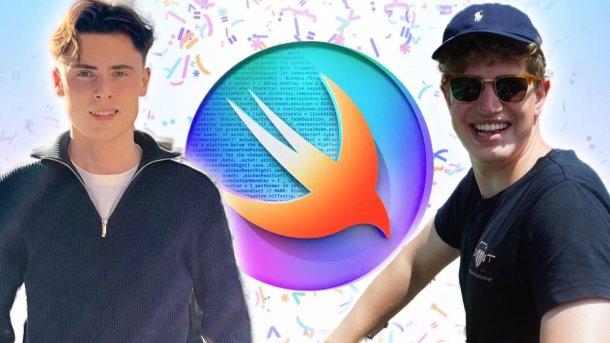
The two Germans Carl Seifert (left) and Tom Steinhauer are among the winners of this year's Apple Swift Student Challenge.
(Image: Fotos: privat, Montage: ho)
Anyone who takes part in Apple's programming competition for young developers, the Swift Student Challenge, quickly learns that brilliance is required in various disciplines: knowledge and correct use of the Swift programming language are of course one thing. A brilliant idea for an app with utility value and a feel for good user interface design are completely different challenges. And whoever emerges as the winner in the end is not obliged to do so, but is invited to present themselves and their app to the public, so they also learn something about marketing. In short: all-rounders are needed.

(Image: Carl Seifert)
Among the 350 winners worldwide this year are once again several pupils and students from Germany, including Jan Steinhauer from Würzburg. 50 participants worldwide, including Carl Seifert from Dresden, were even selected as Distinguished Winners –. They not only receive non-cash prizes and a free developer account for a year, but are also invited by Apple to the WWDC developer conference in Cupertino. In an interview with heise online, the two answered questions about their apps, their motivation and how they got into programming.
Getting started in programming
For Jan Steinhauer (22), it was a YouTube video by influencer AlexiBexi about WWDC 2017 that made a lasting impression on him and got him into programming. “I just thought it was so cool to see that people like you and me, who don't have ten years of programming experience, could do such cool things straight away,” he recalls. The enthusiasm was so great that the then teenager wrote his first lines of code that very night using his father's iPad and the Swift Playgrounds app. And when he tried out his first little app after just a few hours, he couldn't stop, he remembers.
DyLexAid – die Gewinner-App von Jan Steinhauer (3 Bilder)

Jan Steinhauer
)Carl Seifert (22) had a more pragmatic start: at the age of 14, he wanted to automate the Christmas lights at home. “It's fascinating when you somehow enter a few characters into the computer and in the end the computer does exactly what you tell it to,” says Seifert, describing his first contact with programming. “These are key experiences that motivate you to keep going.”
Swift: more than just a programming language
Both developers speak enthusiastically about Swift, the programming language that Apple introduced in 2014. For Steinhauer, Swift is even “like a little brother” with whom he grew up. “I think Swift is one of those languages where you can start small but also expand massively. For me, Swift is a language in which I can fully express myself creatively.”
Carl Seifert is particularly impressed by its versatility: “You can do so much with Swift. The source code is open and freely available. Swift supports a range of operating systems. It's not just Macs that are supported.” He particularly emphasizes that Swift can now also be used on microcontrollers: “The whole thing is called Embedded Swift and is a somewhat reduced version of Swift, so to speak, but completely optimized for small microcontrollers that don't have much computing capacity and memory.”
The projects: From dyslexia help to an interactive periodic table
For his competition entry, Jan Steinhauer developed “DyLexAid”, an app that helps people with dyslexia to read. The app offers various ways to enter texts – whether by direct input, photo, or PDF upload. An algorithm attempts to find simpler words for the input and to streamline sentence structures. In addition, the texts are read aloud using text-to-speech and difficult words are highlighted visually.
ChemBuddy - die Gewinner-App von Carl Seifert (3 Bilder)

Carl Seifert
)Carl Seifert, on the other hand, developed an interactive periodic table for chemistry lessons. His motivation stemmed from his school experiences: “Especially in physics and chemistry, I always had the feeling that some things weren't really intuitive. So I thought that apps could be the right way to make the whole thing more tangible.” He finally implemented the idea of getting more information about the respective element by tapping on it.
The challenges of app design

(Image: Jan Steinhauer)
Both developers emphasize that, in addition to the technical challenges, the user interface design was a major hurdle. Seifert explains: “Ultimately, you want someone to be able to use the apps you develop. They have to be intuitive in some way, people want to want to use them, and you can't really approach them from a developer's perspective, but from the user's perspective. You have to somehow reconcile these two perspectives, and that was always a challenge. I think I've always spent half my time developing a UI where I say: yes, that's it.”
Steinhauer, who studies Human-Computer Interaction at the University of Würzburg, also brings his knowledge in this area to his apps: “I also tried to bring in my knowledge of HCI, i.e., Human Computer Interactions, and give the app a good user interface and a good user experience.”
visionOS and the future of spatial computing
Jan Steinhauer is particularly enthusiastic about Apple's Vision Pro and the possibilities of spatial computing. During his semester abroad at the University of Texas at Austin, he developed the “Viva Monarch” app, which deals with the migration of monarch butterflies. “I was so impressed by it because I just think it's completely different to other VR glasses, as this pass-through mechanism is simply much better, this immersion,” he enthuses about the Vision Pro.
Videos by heise
When asked about the future of spatial computing, he explains: “As a working student, I also have to deal with a lot of other people who develop apps, so I can see that there are two major problems in my opinion: Many people are not yet as familiar with VR and don't understand the gestures as quickly. The second problem is that the Apple Vision Pro is still a bit heavy.” He predicts that with a Vision Pro 2 and later generations, which will be lighter and cheaper, spatial computing will gradually become established.
Community and mentoring: passing on knowledge
It is remarkable that both young developers are already passing on their knowledge to others. Jan Steinhauer runs TikTok and YouTube channels, on which he teaches others about visionOS: “I just wanted to show them: What is possible with the Apple Vision Pro? What input options are there?”
Carl Seifert is involved as a mentor in the “Jugend hackt” education project: “I don't think it's a lack of interest at all, but simply the initial spark that arouses interest. And the conclusion I draw from this is that young people need to be given the space to develop their interests freely and implement their ideas, especially when it comes to promoting diversity in computer science courses.”
Tips for future challenge participants
Jan Steinhauer has an important piece of advice for anyone who would like to take part in the Swift Student Challenge: “The first point is: you have to find something that suits you. Ultimately, your heart has to burn for it.” Attention to detail and the finishing touches are also particularly important: “Many people have a good idea, but the two times I didn't win, I simply lacked that finishing touch.”
The dream of WWDC
For both developers, Apple's Worldwide Developers Conference (WWDC) is a highlight of the year. Carl Seifert, who was invited to Cupertino this time as a Distinguished Winner after winning twice in previous years, is particularly looking forward to the personal exchange: “I'm most looking forward to the contacts and the people I'll meet there. At the end of the day, it's also a networking event. I'm really looking forward to that, but the sessions at WWDC are also really interesting.”
Jan Steinhauer also hopes to be one of the Distinguished Winners next year – He has already made firm plans to attend again: “I've never been to Cupertino or California myself.” He would be delighted to connect with other people there who think along similar lines. “It's simply a great opportunity and chance.”
Future plans: from study to practice
The two students also have clear ideas for their professional future. Jan Steinhauer is already working as a student trainee at SAP in the field of iOS/visionOS development and wants to publish his apps, including DyLexAid and Viva Monarch, in the App Store as soon as he has set up his developer account.
Carl Seifert, who has just completed his Bachelor's degree in Computer Science at TU Dresden, is a research student at the Chair of Distributed and Networked Systems and is working on the Internet of Things, in particular resource-constrained devices. “My main motivator is to improve everyone's life in some way,” he explains his motivation. “And I want to work with people who are committed to their cause, who are dedicated. And my next step on that path is to complete my master's degree.” He also plans to bring his periodic table project to the App Store.


(mki)


