


Fiber optic expansion: Germany will remains a DSL country for the time being
Deutsche Telekom's competitors once again invest less in network expansion, while the Bonn-based giant expands. The industry hopes for the DSL shutdown.
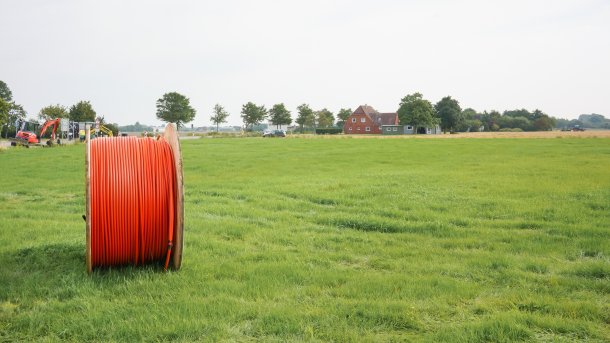
(Image: ThomBal / Shutterstock.com)
In the highly competitive market for broadband and mobile connections, the potential for political disputes remains high: Deutsche Telekom's competitors want to use the upcoming gradual shutdown of DSL copper lines to expand their market share. This is because the DSL market is still firmly in Deutsche Telekom's hands, while other providers dominate the fiber optic market. But providers fear that this could change.
The annual market analysis commissioned by the Association for Telecommunications and Value-Added Services (VATM) provides initial forecasts for the year 2025: According to this, other providers will invest a total of around 6.9 billion euros in the expansion of mobile and gigabit-capable infrastructures. This means that the downward trend will continue, peaking at EUR 8.5 billion in 2022. Deutsche Telekom is different: according to the calculations, it will spend EUR 5.2 billion more on telecommunications infrastructure this year than in previous years.
For the competitors, it is not only the costs that have risen. Large, contiguous expansion areas are slowly becoming scarce. But the potential is actually there: Of the 39.2 million fixed lines, 23 million are DSL lines and 1.7 million are narrowband lines. The cable TV infrastructure, which has been further upgraded in recent years, still covers 8.4 million households. And high-speed fiber optics? Only 6.1 million connections so far.
Homes Passed vs. Homes Activated
The outgoing German government originally set itself the goal of supplying half of all households with fiber optics by 2025 and all households by 2030. And in many places, fast lines are already lying dormant in the ground – By the end of the year, competitors are expected to have laid their cables past 12.2 million households, 1.2 million more than at the end of 2024. Deutsche Telekom is even expected to jump from 10.1 to 12.6 million households, which would theoretically be covered.
However, “Homes Passed” does not mean that the households are actually connected. Just 1.5 million or 14.9% of the households reachable at the end of 2024 had actually booked a fiber optic connection with the former monopolist, the so-called Homes Activated. According to the VATM market analysis, almost three times as many (33.6%) of the competitors had 3.7 million. According to the study, by the end of 2025, there would be 2 million active Telekom fiber optic connections and 1.8 million additional Homes Connected, compared to 8.8 million households that are only connected on paper.
Deutsche Telekom's competitors see this as a preparatory measure for the shutdown of the copper network on which DSL technology is based: Deutsche Telekom still dominates the market today. A profitable business: because even if other providers offer customers a DSL contract, this is usually based on line capacity leased from Deutsche Telekom.
Little willingness to switch
The technical end has actually already been reached for DSL, the technology is exhausted and components will also become scarce in the medium term, as hardly any country relies on DSL anymore. However, in their forecast for VATM, the authors of the study come to the following conclusion: DSL will remain the dominant line technology in Germany until 2030 in all scenarios, as there has been no pressure to date. Although this could change – the coalition agreement of the next German government does not contain any concrete political guidelines in this regard.
However, as long as the DSL infrastructure is in place, there is no reason for many users to switch. According to the VATM market analysis, users' hunger for data has increased further and is likely to grow from 321.5 gigabytes per month to 342.7 gigabytes per fixed-line connection. However, for many users, the 250 megabit/s that VDSL connections provide in the downstream have so far been sufficient, at least for 4K streaming services.
Videos by heise
In addition, companies are still finding it difficult to market fiber optic connections: the main sales channels are poorly reputed door-to-door sales representatives. In one recent case, Deutsche Wohnen, which belongs to the Vonovia Group, issued a general ban on Deutsche Telekom's fiber optic representatives. According to VATM, this is an isolated case: “We are only aware of Deutsche Wohnen issuing a ban on a large housing company.” Years ago, the association had already committed its member companies to the so-called door-to-door code, which sets minimum standards for door-to-door sales and to which Telekom has also voluntarily submitted.
Market likely to consolidate further
VATM Managing Director Frederic Ufer does not expect any of the current 270 or so fiber optic providers to remain on the market in the long term in the face of fierce competition: “Telecommunications is a business of scale that can only really be profitable with six or seven-digit customer numbers.” Ufer believes that municipal providers in particular, who operate on a regionally limited basis due to their mandate, will leave the market in the medium term: “There will be very natural processes for such providers to leave the market or switch to other business models such as passive infrastructure.”


(mma)


