

Citroën C5 Aircross compact SUV comes as a hybrid, PHEV and electric car
Citroën will launch the C5 Aircross in late 2025, featuring more space, glass roof, and 680 km electric range

(Image: Citroën)
The platform strategy of the major car manufacturers enables a diversity that would simply be inconceivable without it. For manufacturers, this primarily means lower costs for a broader range. Stellantis follows this strategy and offers the STLA platform in various packages. Opel and Peugeot have already started with the Grandland and 5008, now Citroën is following suit with the C5 Aircross. It will be available with hybrid and battery-electric drive from fall 2025.
The glass roof can be opened
Similar to Opel, Citroën has also made a significant increase in size with the model change. The SUV has increased in length by 15 centimetres to 4.65 meters. The wheelbase accounts for six centimeters of this increase. It now measures 2.78 meters. The trunk has a capacity of 651 liters –, which is plenty for this class, especially as this figure applies regardless of the drive system. By their own admission, the developers have paid particular attention to comfort. The seat and the lower part of the backrest are particularly thickly upholstered. They can be optionally heated, ventilated and equipped with a massage function. The shock absorbers have two progressive stops, with which the response is said to be particularly sensitive. As an option, Citroën offers a large glass roof, a small section of which can be opened.
Citroën C5 Aircross Exterieur (6 Bilder)
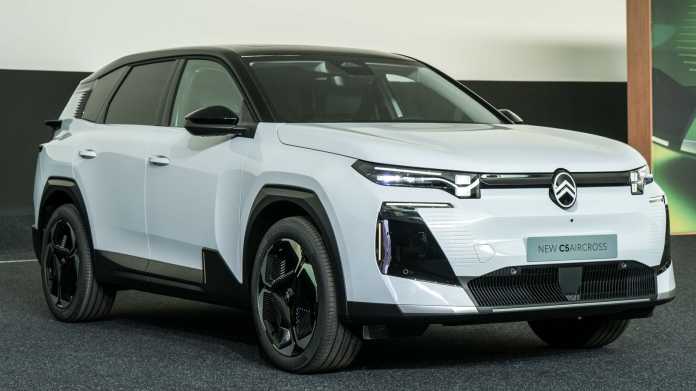
Citroën
)The infotainment system integrates the ChatGPT AI. This means that voice commands can be processed much more comprehensively than before. However, Stellantis also has some catching up to do in this area. Part of the interface of the multimedia system can be set up flexibly. The user can therefore make the operation of functions that they frequently need more easily accessible – always a good idea. The inductive smartphone charging cradle charges with a maximum of 15 watts. Other manufacturers offer more.
Semi-automated lane change
Citroën also stays within the bounds of what is usual in this class when it comes to assistance. There is a semi-automated lane change, which is activated at the touch of a button after a check – if the speed is above 70 km/h and the road has several lanes in each direction. Stellantis continues to keep its distance from highly automated driving in this class. The sensor technology required for this is currently so expensive that Citroën probably quite rightly assumes that only a tiny proportion of the C5 Aircross target group would pay for it.
Initially, customers will have a choice of four drive systems. The base model will be the familiar 1.2-liter mild hybrid, which will of course be upgraded to 107 kW system output. It combines a 1.2-liter three-cylinder engine with 100 kW and an electric motor with 21 kW, which is integrated into a six-speed dual-clutch transmission. The buffer battery is small at 900 Wh, but the aim is not to drive electrically, but to increase the efficiency of the combustion engine. The electric motor always takes over when the petrol engine alone would be particularly inefficient.
Lame charger
The second in the group will be a plug-in hybrid with a system output of 143 kW. The petrol engine delivers 110 kW, the electric motor 92 kW. Here too, the drive power is less than the calculated total because the engines deliver their peak power at different speeds. It is disappointing that the 21 kWh battery can only be charged with a maximum of 3.7 kW as standard. For an extra charge, Citroën offers an internal charger with 7.4 kW, but this also only charges with a single phase. This means that the C5 driver cannot charge faster with the standard 11 kW wallbox. As a rule, there is now an advantage with public charging infrastructure. Why Stellantis is sticking with these lame chargers remains somewhat incomprehensible. The competition is much further ahead almost everywhere. The range in the WLTP should be 86 km.
Citroën C5 Aircross Interieur (7 Bilder)
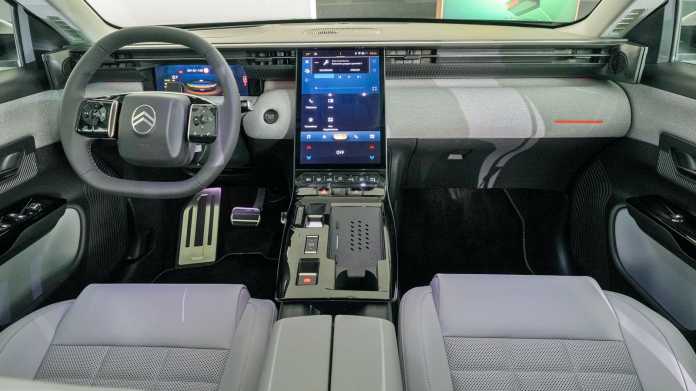
Citroën
)Citroën is presumably counting on the fact that customers who want to drive electrically will opt for one of the two battery-electric drives anyway, thus saving themselves the detour via the plug-in hybrid. At 157 and 170 kW, they are close to each other in terms of output, but differ significantly in terms of the energy content of the traction battery. The base model of the ë-C5 Aircross already has 73 kWh, the "Long Range" variant 97. The range in the cycle should be 520 and 680 km.
Direct current charging up to a maximum of 160 kW
Citroën also keeps a safe distance from the top when it comes to charging. Up to 160 kW is possible with direct current. To close the window between 20 and 80 percent, 30 minutes are required for the small battery and 27 for the larger one. A comparison of the average net charging power in this range demonstrates how big the difference is between the two storage systems. The small battery achieves 87.6 kW, the large one 129.3. After 30 minutes, the 73 kWh battery ideally has 43.8 kWh recharged, while the 97 kWh battery has 58.2 kWh after 27 minutes. These values apply under ideal conditions, and the charging losses still have to be added.

Initially, only up to 11 kW are possible on alternating current. Next year, Citroën also plans to offer a charger with 22 kW. A heat pump is fitted as standard. In its announcement, the manufacturer leaves open whether there is any preconditioning of the battery cells. We assume that Stellantis will not risk disappointing customers in the winter in the medium term at the latest. A Peugeot e-5008, which was in the editorial office at the end of last year, impressively demonstrated how important this functionality is. Due to a lack of pre-tempering of the battery cells, it only charged at just over 50 kW in frosty conditions despite driving several kilometers to the charging station.
Videos by heise
The C5 Aircross is built in Rennes, France. The SUV is expected to be available at German dealerships from fall 2025, although Citroën has yet to decide what it will charge. The models of its internal competitors are likely to provide an initial guide. Opel charges at least 36,400 euros for the Grandland, and at least 10,000 euros more for the electric car. Peugeot charges from 40,080 euros for the slightly shorter 3008 and 48,650 euros for the version with electric drive. If you calculate around 40,000 euros for the mild hybrid and around 48,000 euros for the ë-C5 Aircross, you will probably come very close to the list price.
(vbr)