


Blackout in Spain and Portugal: At least three dead after power outage
The massive power outage on the Iberian Peninsula has cost at least three lives. The search for the cause of the outage continues.
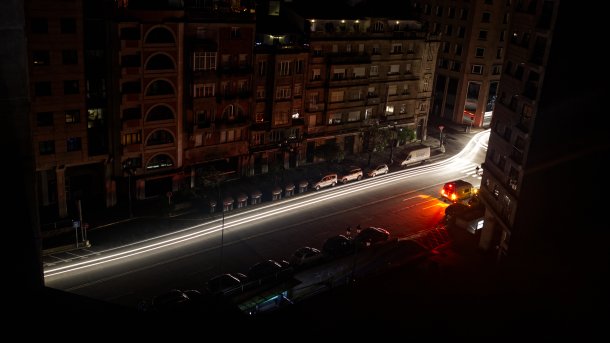
The city center of Vigo without electricity
(Image: Seoane Prado, CC BY-SA 4.0)
After the historic power outage in Spain and Portugal, the search for the cause continues. Meanwhile, it has become known that at least three people have lost their lives as a result. According to the Galician newspaper “La Voz de Galicia”, three people aged 81, 77 and 56 from the small north-western Spanish town of Taboadela have died. The oldest needed a ventilator and when the power failed, a petrol-powered emergency generator went into operation. Its exhaust fumes probably spread unnoticed throughout the house, and the couple and their son died of carbon monoxide poisoning, the newspaper writes.

The search for the cause
Meanwhile, the Spanish electricity grid operator REE (Red Eléctrica de España) announced early on Tuesday that 99.95 percent of electricity demand could be met again, and that normalization would soon be completed. Spain's Prime Minister Pedro Sánchez made a similar statement, but his government has not yet provided any information on the cause. According to El País, investigations into a possible cyberattack have now been opened at Spain's central criminal court, after allusions to this had previously been rejected. Sánchez has firmly rejected the claim that a lack of nuclear power plants was the cause.
Videos by heise
Following the newspaper's early report that 60 percent of electricity generation disappeared from Spain's grid for five seconds on Monday afternoon, which ultimately triggered the blackout, there are now assessments of this. The spokesperson for the Helmholtz Association's national energy system design program, Veit Hagenmeyer, told the Science Media Center (SMC) that the power grid in Europe is not designed to cope with the loss of so much generation capacity. A loss of 3 GW could be compensated for, but not the 15 GW suddenly missing here. This is why there were scheduled shutdowns, which spread in cascades and later helped with reactivation.
Due to this series of shutdowns, it is still not possible to say what caused the power outage. According to Hagenmeyer, he is not aware of such a large drop in power, but recalls that in 2006, emergency shutdowns spread from Germany to Western Europe similarly and even reached Spain. In 2021, such a cascade was prevented when a fault occurred in Croatia. Whether an incident like the one on the Iberian Peninsula could be prevented if it were to occur in Germany can only be said once the exact cause is known.
Several parallel incidents necessary
Christian Rehtanz, Head of the Institute for Energy Systems, Energy Efficiency and Energy Economics at TU Dortmund University, added to SMC that several extraordinary events or technical faults would have to come together for such a massive blackout. This could always happen, but the overall probability is very low, as several extremely rare and unfavorable combinations always have to occur simultaneously. Rehtanz adds that the control systems record all events in high resolution and that a precise analysis of the events will be possible on Monday afternoon. Until then, statements about the possible cause are pure speculation.
Miguel de Simón Martín from the University of León in Spain also told SMC that there were indications that a high-voltage line in France had suddenly failed. The voltage drop could have led to photovoltaic and wind power plants being disconnected, causing the system to collapse. This is particularly vulnerable due to the small number of connections to the continental European electricity grid, which is why more connections are needed. This is already being worked on. If the hypothesis is confirmed, a recurrence in the near future would be unlikely.
Simón Martín also explains that the Spanish electricity grid is being radically transformed by the shift towards renewable energies. The more of these cover the electricity demand on the Iberian Peninsula, the less room there is to react to disruptions. It is therefore essential to install more electricity storage systems and develop microgrids that can be disconnected in an emergency and self-supplied from different energy sources. This could increase the flexibility and resilience of the power supply. However, technical developments are still needed to achieve this.


(mho)

