


Without a motor: cable car robot moves loads with just infrared light
The soft robot in the shape of a Rotini noodle is powered by infrared light and can also overcome obstacles.
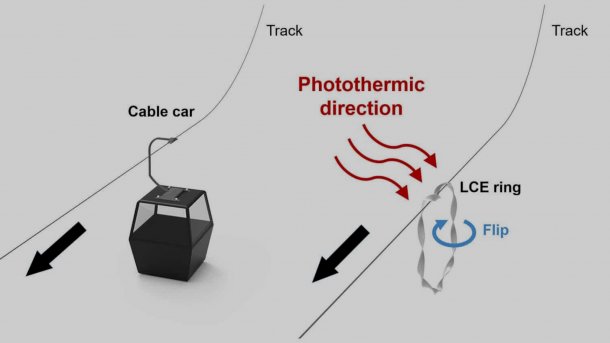
Schematic representation of the function of the ropeway robot driven by infrared light.
(Image: North Carolina State University)
A team of engineers from the Department of Mechanical and Aerospace Engineering at North Carolina State University (NC State) has developed a ribbon-shaped soft robot that can move along a rope powered by infrared light. The robot can also transport loads more than twelve times its weight.
The robot consists of a ribbon of liquid crystal elastomer that is twisted like a Rotini noodle and joined to form a loop. The ring-shaped robot is then slid over a thread or wire that is stretched between two connection points. The material of the rope is irrelevant, as the researchers explain in the study “Aerial Track-Guided Autonomous Soft Ring Robot”, which was published in Advanced Science. The elastomer ring is looped around the wire at least two to three times and hangs parallel to it.
Movement with infrared light
The soft robot is irradiated with infrared light perpendicular to the guide wire. The part of the robot that absorbs the most light contracts. This results in a rolling movement, during which the cooler part of the belt is drawn into the light. The previously irradiated part then turns away from the light and cools down. This is then repeated so that the soft ring rotates around itself and pulls itself along the wire. The soft robot, which weighs around 0.46 g, can transport more than twelve times its weight – i.e., around 5.52 g.
Empfohlener redaktioneller Inhalt
Mit Ihrer Zustimmung wird hier ein externes YouTube-Video (Google Ireland Limited) geladen.
Ich bin damit einverstanden, dass mir externe Inhalte angezeigt werden. Damit können personenbezogene Daten an Drittplattformen (Google Ireland Limited) übermittelt werden. Mehr dazu in unserer Datenschutzerklärung.
The scientists not only had the robot move along a taut wire rope, but also on exposed wire tracks and rails of different shapes and thicknesses. The robot was able to move along tracks the thickness of a human hair and a drinking straw without getting stuck. It could negotiate inclines, descents and smaller obstacles.
“We also showed that it can follow complex routes – it doesn't necessarily have to be a straight line,” says Fangjie Qi, first author of the study and PhD student at NC State. “We have shown that it can follow curved lines, circles, three-dimensional spirals and so on in a controlled manner. We believe that the robot's adaptability in navigating complex patterns predictably is promising for its utility in practical applications.”
Videos by heise
The researchers still want to think about the practical benefits. They have not yet found a specific application. Until then, however, the scientists want to further develop the robot so that it can also react to other external energy sources and not just infrared light. The researchers are considering sunlight, for example.



(olb)

