


Flying squirrel drone flies better than conventional drones
Can quadrocopters perform flight maneuvers even better? Yes, say South Korean researchers who have equipped a drone with variable wings and AI control.
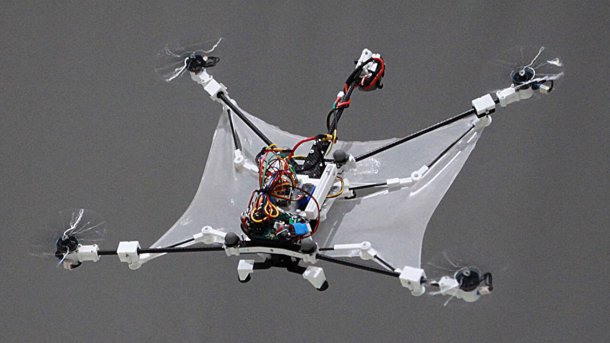
The flying squirrel drone adjusts its silicone wings independently depending on the flight situation.
(Image: Dohyeon Lee, jun-Gill Kang und Soohee Han)
A team of scientists from South Korea's Pohang University of Science and Technology and the AI Autonomy Technology Center of the Agency for Defense Development (ADD) have developed a four-engine drone with folding wings inspired by a flying squirrel. Thanks to the variably adjustable wings, the drone achieves significantly better flight behavior during special flight maneuvers. The flying squirrel drone itself decides which maneuvers the flying robot uses the folding wings for and how.
Flying squirrels, a species of squirrel that has a flap of skin stretched between its front and hind legs to enable it to fly over jumps between trees, have amazing flight characteristics. They not only use the skin flaps as wings for gliding, but also use them to slow down their flight in order to land more gently on a tree or branch.
The South Korean scientists have taken this squirrel species as a model to improve the flight characteristics of a quadrocopter drone, as they write in the study "A highly maneuverable flying squirrel drone with agility-improving foldable wings", which has been published in the preprint on Arxiv. The researchers started from the assumption that the drone can expand its dynamic capabilities by using the folding wings to take advantage of air resistance when spreading its wings.
Variable wings with AI control
The scientists equipped the quadrocopter with a motorized mechanism that can be used to extend and retract silicone wings. The wings generate additional lift in flight, but can also be used to slow down the flight during certain maneuvers – depending on how much the wings are retracted or extended. This allows the system to achieve high performance when performing maneuvers with high acceleration, such as quick stops and tight turns.
Empfohlener redaktioneller Inhalt
Mit Ihrer Zustimmung wird hier ein externes YouTube-Video (Google Ireland Limited) geladen.
Ich bin damit einverstanden, dass mir externe Inhalte angezeigt werden. Damit können personenbezogene Daten an Drittplattformen (Google Ireland Limited) übermittelt werden. Mehr dazu in unserer Datenschutzerklärung.
However, it took a long time to get there. This is because the wing membrane impairs flight performance in conventional flight scenarios and leads to inaccurate straight and level flight, for example. "In order to work safely and reliably in these scenarios, the flying squirrel drone must be able to decide when to extend or retract its wings depending on the situation, and the rotors must be able to generate the corresponding thrust," explain the three scientists involved, Dohyeon Lee, Jungill Kang and Soohee Han.
The three researchers trained an artificial intelligence (AI) to predict how high the air resistance generated by the silicone wings would be in the respective flight situation. In addition, they developed thrust-wing coordination in order to be able to control the wings and drive rotors with the predictions of the air resistance in such a way that optimal flight control is achieved. The rapid retraction and extension of the silicone wings maintains the conventional flight characteristics of the quadrocopter and supports and thus improves them in special flight situations.
According to the scientists, the air resistance algorithm does not require high computing power. They use a simple Arduino-class microcontroller for the onboard calculations. Accordingly, the system can also be used quite easily on other quadrocopter drones.
"We are now planning to implement additional functions inspired by real flying squirrels. In particular, we want to investigate the gliding behavior of the flying squirrel drone and develop a type of landing frame and control strategies that allow the drone to slow down quickly and land on walls or trees, similar to real flying squirrels," say the three researchers.
Videos by heise
In a further step, they want to investigate the motion planning of the flying squirrel drone in more detail in order to be able to better control the dynamic properties of the flight system, which change depending on the flight situation.



(olb)

