


It's alive! Dragonfly BSD 6.4.1 released with many bug fixes
The developers at Dragonfly BSD can hardly keep up with the fixes from FreeBSD. A version 6.6 is due soon, but so far there are only enough important patches.
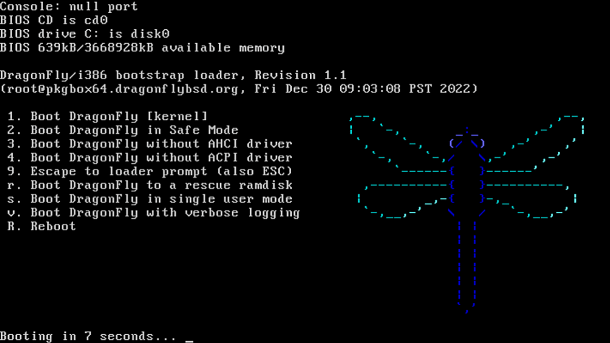
- Michael Plura
Dragonfly BSD has been virtually silent for two and a half years. Now the developers around Matt Dillon have surprisingly released Dragonfly BSD 6.4.1. The meagre announcement on the project page lists just four fixes. Only a look at the long and detailed list of all changes reveals that the FreeBSD fork intended for use in the data center is actually still being worked on.
A March 1 post by Dragonfly BSD developer Aaron Li hints at a manpower bottleneck: "We are still fixing 2024Q3 of FreeBSD ports and it seems to be taking some time. I'm sorry I don't know the timeline. We currently only have a handful of developers working on the packages and it's getting harder and harder to keep up with FreeBSD."
Most important fix: pkg(8) no longer breaks package management
Besides many improvements for the HAMMER2 file system, the most relevant fix in practice is probably the pkg(8) package management fix: A "pkg update" could under certain circumstances make the package manager configuration file /usr/local/etc/pkg/repos/df-latest.conf unusable and thus lead to the error "No active remote repositories configured.". Due to problems with the Avalon repository [TLS certificate failure], the developers have updated the ca_root_nss package to trust current Let's Encrypt certificates.

A bug in the IDE/SATA driver, which could lead to a kernel panic due to a memory leak, has also been fixed. Problems in connection with UEFI systems have also been fixed.
Videos by heise
DragonFly BSD was forked from FreeBSD 4.8 by Matt Dillon in 2003 to create a BSD specifically for server and cluster operation with its kernel thread and SMP optimizations. Dragonfly BSD is best known for its modern, distributed file system HAMMER2. It is released under the free BSD license and is only available for the x86-64 platform. The changes in the new version can be read in detail in the changelog, ISO images for installation at VPS providers are freely available on the project page.


(mack)

