


Smart Home: New Matter version pairs multiple devices via NFC tag
Version 1.4.1 of the Matter smart home standard facilitates the installation of a wave of new LED bulbs and already installed flush-mounted switches.
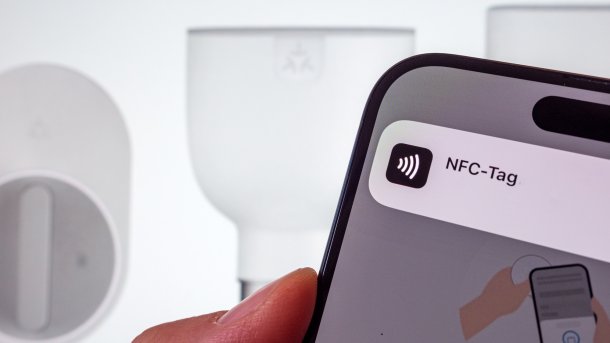
Future Matter devices such as LED bulbs can be linked via NFC as an alternative to the QR code.
(Image: Berti Kolbow-Lehradt)
The Matter communication protocol is designed to bring smart home components from different manufacturers under the umbrella of overarching control software from Amazon, Apple, Google, Samsung or Home Assistant as easily as possible. The recently released Matter version 1.4.1 adds three new options for the pairing process.
New rules for the QR codes used for pairing are practical for commissioning large installations. Instead of the previous maximum of one device, several devices can now be added to the desired system at once (multi-device setup QR code). According to the Connectivity Standards Alliance (CSA), the certification organization responsible for Matter, one example of an application is multiple packs of products such as LED bulbs or adapter plugs. Finding the right QR code for each individual product and then scanning it one by one can be tedious. Collective codes are intended to speed up the process.

Pairing via NFC
Instead of QR codes, devices can now also be paired using NFC tags. Matter allows NFC chips to be integrated into components. This means that you only need to hold your smartphone up to it to pair the device. This second new feature of Matter 1.4.1 is practical for LED bulbs that are screwed into sockets or flush-mounted switches that are already installed. QR codes are often found as stickers on the devices themselves and are no longer accessible in such cases. The devices must be removed at the latest after a reset and renewed pairing requirement. This is no longer necessary if contact via NFC is sufficient.
Videos by heise
The third innovation concerns the small print. It enables accessory manufacturers to display windows with terms and conditions and obtain consent during the pairing process in overarching system apps. Previously, they could only do this in their own branded apps.
The new Matter specifications have now been published and the corresponding development tools are available on Github. For the first time, the CSA is extending the standard beyond the six-monthly update cycle. It is not possible to predict when hardware and software manufacturers will adopt the update. Experience has shown that it sometimes takes a few weeks for Matter innovations to be put into practice, but more often a year or longer.


(mki)

