


Electrification of German railroad tracks is making slow progress
For years, progress on equipping railroad lines with overhead lines has been slow. However, supporters of electrification are now raising their hopes.
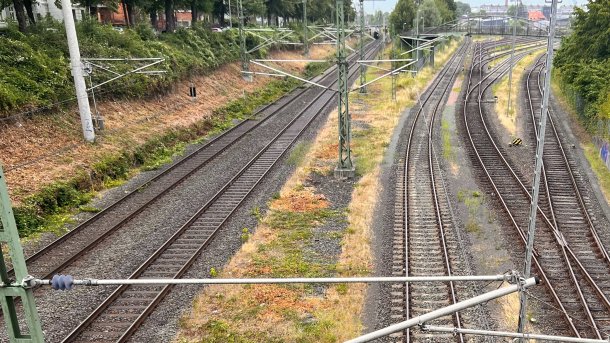
Track systems in Lübeck.
(Image: heise online / anw)
The electrification of railroad lines in Germany that have not yet been upgraded accordingly is only making slow progress. In 2024, only 20 kilometers of track were equipped with contact wire, and just 45 kilometers are expected for 2025. This means that a third of Germany's railroad lines can still only be used by diesel vehicles, according to the Association of German Transport Companies (VDV) and the Pro-Rail Alliance.
Between 2020 and 2025, the proportion of electrified routes rose from just 61 to 62 percent. Five years ago, the German government's goal was to have three quarters of the rail network electrified by 2025 – The reality is a long way from that.

New hope through change of government
The two associations are nevertheless hopeful: the new federal government has resolved to significantly simplify the electrification of the rail network. The two associations expressly welcome the fact that, according to the coalition agreement, the time-consuming benefit-cost calculation will no longer be necessary in future . Up to now, the economic benefits of the expansion first had to be proven. However, the new black-red government has not set itself a clear expansion target.
However, the associations believe that 80% by 2035 is feasible. In addition to reducing bureaucracy, they hope that the additional financing via the Climate and Transformation Fund that has also been announced could contribute to this. They are also hoping that the increased investment in military projects will provide an impetus to electrify further routes to enable military transportation. Another factor in speeding up secondary lines could be the elimination of overhead lines, which are designed for higher speeds. A standard overhead contact line for 100 km/h could reduce construction work and costs.
Videos by heise
The two associations have paid particular attention to the routes at border crossings. Here, only 28 out of 57 crossings are equipped with overhead lines. There is a particular need to catch up at the borders with Poland and the Czech Republic.


(mki)

