


Raspberry Pi OS: Small improvements in the last version before "Trixie"
The developers have improved the Raspberry Pi OS once again, the last time before switching to the Debian Trixie basis.
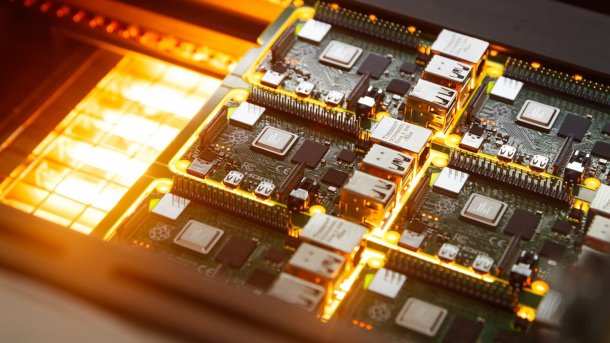
(Image: Raspberry Pi Foundation)
The developers have released an updated version of the official Raspberry Pi operating system Raspberry Pi OS. There are no major new functions, but there are minor improvements. This is probably the last update for the version based on Debian Bookworm.
The Raspberry Pi developers provide an overview of the changes in an article. Firstly, they point out that Debian uses a two-year cycle for new versions and that the new "Trixie" base is therefore expected in the summer. There have been some changes since the last release last November.
Improvements to the lock screen
The screen lock with "swaylock" had the disadvantage that it only displayed a white screen without any indication of what had happened or what needed to be done. Now the key combination Ctrl, Alt and "L" or the selection via the "Shutdown" menu and the selection of "Lock screen" leads to a screen with a minimalist background graphic and a password input box. In this context, there is another change: the auto-log-in function is activated by default for the Raspberry Pi desktop. However, this means that the first of the text-based consoles (TTY), which can be accessed under Linux by default via the key combination Ctrl, Alt and the function keys F1 to F7, is automatically logged in. It would therefore be possible to access a logged-in session from the lock screen by pressing Ctrl, Alt and F1. To prevent this, the automatic log-in can now be set separately for the console and graphical desktop. Separate switches are available for this in both "raspi-config" and the graphical Raspberry Pi configuration.
Touch screen handling is also said to have been improved. Wayland supports touchscreens rather rudimentarily, so that a double-click, for example, cannot be triggered by double-tapping. Up to now, Raspberry Pi OS programmers have made do by activating mouse emulation by default. However, this had the disadvantage that touch gestures such as swiping on the screen to scroll did not work. Now there is a "Touchscreen" section in the screen settings where users can switch between touchscreen and mouse emulation mode as they wish. Since the double-click is missing in touch mode, especially in the file manager, interested users can use the "Open files with one click" option in the settings or press-and-hold to open the context menu and select "Open".
Instead of a self-programmed Python app for managing printers, the developers have also ported Gnome's printer control into a stand-alone printer app. The developers hope that this will make printer management more intuitive.
Videos by heise
Package maintenance
The Wayland window manager "labwc" is still in version 0.8.1. This means that it is several releases behind the latest version, but has undergone a lot of testing and proved to be very stable. However, the developers want to upgrade the version in the near future. The kernel version jumps from 6.6 to 6.12, specifically to 6.12.25 at the time of reporting.
Due to changes made by the Chromium developers, the uBlock Origin ad blocker can no longer be installed by default. However, as this still works with uBlock Origin Lite, the maintainers have switched to it. They have also put some work into optimizing the startup time of the "wf-panel-pi" app, which displays the taskbar in Wayland, resulting in a noticeably better boot time from startup until the desktop appears. The "zenity" tool was previously used to generate prompts and dialogs at the command prompt. By programming your own tool "zenoty", you can save the installation of some packages that have also increased the boot time. Some changes under the hood are intended to simplify the maintainability of the desktop and the switch to the "Trixie"-based Debian foundation.
The update can be carried out on running systems by calling the commands
sudo apt update
sudo apt full-upgrade
commands. However, if you are sitting at a computer that switches to sleep mode after a short period of non-use, you could risk the SSH session to the Raspi being terminated. It is recommended to start a shell such as "bash" (command: screen bash) with the command "screen" (installable by calling sudo apt install screen) and then initiate the updates. The process then continues even if the connection is interrupted and can be restarted after logging in again with the command screen -r.
Finally, sudo reboot triggers the reboot to activate the new software version. New images and the Raspberry Pi Imager are also available for download on the Raspberry Pi software page.

The Raspberry Pi OS update from the end of October last year had even more far-reaching changes. For example, the developers managed to get Wayland support running for all Raspberry Pi models and not just on the latest boards.


(dmk)

