


Software can reconstruct faces from genetic material using AI
Chinese researchers have developed software that calculates a person's appearance from their genetic make-up. It could be used in forensics.
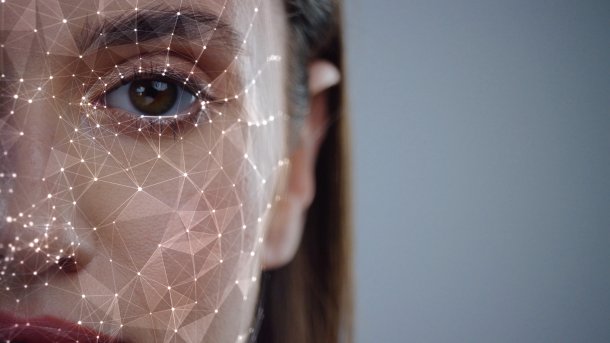
(Image: Fractal Pictures/Shutterstock.com)
Information about the whole person is encoded in their genetic material – including their face, as Chinese researchers have discovered. They have developed software that uses artificial intelligence (AI) to reconstruct a face from DNA.
Difface is the name of the software developed by the team led by Mingqi Jiao from Hangzhou University in the eastern Chinese province of Zhejiang. It is "a multimodal model for reconstructing 3D facial images exclusively from DNA", the team writes in the journal Advanced Science. The model is based on "artificial intelligence techniques in text-image synthesis".
Difface uses single nucleotide polymorphisms (SNPs) –, which are variations of base pairs in DNA –, to generate 3D point clouds. The point cloud then represents the face of a person.
Data set of almost 10,000 people
The team trained its model using a data set of 9,674 people. In addition to 3D scans of the faces, this also contained genome sequences of the test subjects. The system first analyzed which SNPs were associated with which facial structures.
In the next step, the researchers then had the system reconstruct the corresponding face from DNA that was not part of the training data. The reconstructed face deviated from the real one by an average of just 3.5 millimeters.
If the system was provided with additional parameters such as a person's age, gender and body mass index, the result was even more accurate. The deviation was then 2.9 millimeters.
According to the researchers, the system is even able to predict a person's appearance at different ages. However, not every part of the face can be reconstructed equally well. For example, Difface can calculate a nose more accurately than the shape of the cheeks or the position of the eyes. The result is also worse if the complete genetic material is not available.
Videos by heise
Application in forensics
The developers see forensics as the most important area of application: DNA samples from a crime scene could be used to reconstruct the faces of victims or suspects. So far, however, this has only worked with the faces of Han Chinese, the researchers emphasize.
Historians could also benefit: Should DNA still be extracted from a historical skeleton find, the face could be reconstructed more easily than with the soft tissue reconstruction used so far. Other potential applications could be in medicine, for example in the preparation of operations.
The researchers are aware that this technology also has far-reaching implications for privacy. They are therefore explicitly calling for a scientific and social debate on the subject.


(wpl)


