


Redesign for Android 16 and Wear OS 6: Google refreshes its operating systems
Google announced new features for Android 16 and Wear OS 6 during the Android Show: The focus is on the major visual redesign Material 3 Expressive.
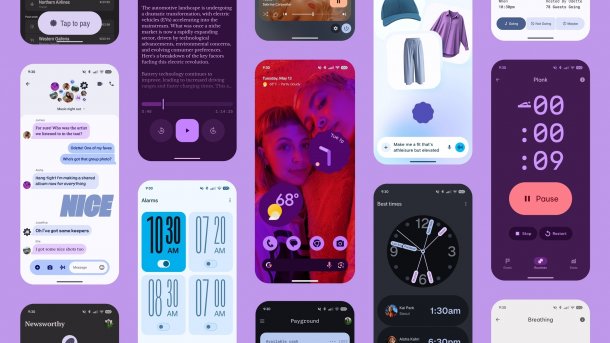
Material 3 Expressive: Android 16 and Wear OS 6 get a major visual refresh
(Image: Google)
As part of the Android Show 2025, Google has unveiled the biggest design update for Android in four years. The new design language builds on the “Material You” introduced in 2021, which in turn was a continuation of Material Design from 2014. The refreshed design language will initially be used in Pixel smartphones and smartwatches with Android 16 and Wear OS 6.
According to Google, the new approach is the Group's most extensively researched design language, which is intended to appeal to the broadest range of users across generations. According to the company, Material 3 Expressive is the result of three years of work in which 46 studies were conducted with more than 18,000 participants to create a new design that is both emotional and useful.
According to Google, Material 3 Expressive aims not to be just another new coat of paint on the system, but to “evoke emotions, convey functions and help users achieve their goals”.
Material 3 Expressive: More than just new color nuances for Android 16 and Wear OS 6
According to Google, elementary components of the new design are “the use of color, shape, size, movement, and limitation”. With the design language, the company has identified relevant core aspects for the user-friendliness of a product “by drawing attention to what is important on the user interface,” it says.

(Image: Google)
In the course of the studies, Google found that participants were able to “recognize the most important UI elements up to four times faster” when using Material 3 Expressive. As an example, the company cites a direct comparison between the current Gmail app and a concept of the Material 3 Expressive interface. In the app's updated design, the send button is larger and therefore easier to recognize.
Android 16 and Wear OS 6: Redesign for Google apps too
With the update, the new OS versions will receive updated dynamic colour themes, responsive components and a new typography that allows the devices to be more individualized, according to the company. The visual updates will gradually be made available for all Google apps such as Photos and Gmail. The manufacturer is also offering app developers all kinds of support for adapting their apps for Material 3 Expressive. As with Google's Material Design, the design language is likely to end up in other company services such as Chrome sooner or later.

(Image: Google)
Visual changes and greater customizability run through the entire system: the quick settings will be more extensively adapted, and the individual tiles will be displayed in different sizes. Google is also using a partially transparent background for the quick settings, notifications, and the app drawer, which looks like frosted glass.

(Image: Google)
In addition to the new visual accents, Google is introducing animations that appear “more natural and bouncy” and are intended to “break up everyday routines”. For example, when a notification is hidden, the adjacent notifications react to the interaction. The new animations are also accompanied by haptic feedback and sound.

(Image: Google)
Another Android 16 function that Google had already announced with Beta 1 is “Live Updates”. This can be used to track progress notifications from selected delivery, ride-sharing and navigation apps in real time on the lock screen or in the notifications. It is somewhat reminiscent of Apple's Live Activities, but the feature is more limited in terms of functionality on Android.
Wear OS 6: Material 3 Expressive optimized for round screens

Google has adapted Material 3 Expressive to round screens for Wear OS 6. The design “is fluid by nature, with scrolling animations that trace the curvature of the display,” it says. When scrolling, for example, lists are to be animated in order to “convey a sense of depth and make information more accessible”.
Videos by heise
Google has also refreshed functions such as the use of the pinpad (for entering the security PIN) and the control of media through movement and faster feedback. Google has also optimized UI elements for the smaller screen size.

(Image: Google)
With Wear OS, Google is also bringing the dynamic color theme to the watch, which has been part of Android for years. The colors of the selected watch face are extended to the entire system.

(Image: Google)
Wear OS 6 also integrates new buttons which, according to Google, are space-saving, easier to tap and adapted to the round screen. The tiles should also be “more space-saving and appealing”. They “provide quick access to the most important information or actions”, such as sending text messages or starting a workout.
Wear OS 6 has not only received a visual update, the wearable OS has also been improved in terms of power consumption. Google promises up to 10 percent longer battery life with the update.
Android 16 and Wear OS 6 will initially land on Pixel smartphones and watches. According to Google, it is working with hardware partners to bring the new design to other devices. A first beta with Material 3 Expressive is to be made available for Pixel smartphones shortly. The final release of Android 16 is scheduled for the second quarter.


(afl)


