


Bold thesis: LCDs will remain the dominant display technology in the future
OLEDs are too expensive and not scalable, micro-LEDs are unmanageable and self-illuminating quantum dots are immature. A damning verdict, isn't it?
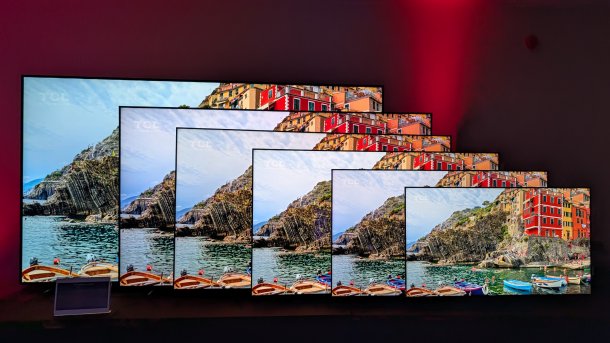
Marek Maciejewski is certain that the future belongs to LCDs with mini-LEDs. This is mainly due to the costs and the possibility of producing large diagonals, explains the European head of development at Chinese TV manufacturer TCL. OLED manufacturers would not be able to produce sets with diagonals of well over 80 inches, i.e. 2 meters, at least not at reasonable prices.

(Image: Ulrike Kuhlmannn, c't)
Liquid crystal displays with a locally dimmable backlight made of small mini LEDs, on the other hand, are much more scalable. And with a large number of diodes, they achieve excellent contrasts and, above all, a very bright display. Here too, LCD TVs have an advantage over other technologies such as OLEDs. In contrast, the product manager believes that televisions with micro-LEDs per pixel have little chance of success. Their control is extremely complex and the transfer of the tiny light-emitting diodes from small wafers to large substrates is an as yet unsolved problem, which he believes will not be solved in the future either.
Self-luminous quantum dots
Last year, TCL and its parent company CSOT showed the first prototypes of displays made from self-illuminating quantum dots at Display Week in the USA. However, Maciejewski also believes that these have little potential for TVs.

(Image: TCL)
The electroluminescent quantum dots (EL-QDs) are excited to glow with an electric current, whereby the nanoparticles have to be applied to the substrate using a printing process. The printing of the particles is not fully developed, and large diagonals in particular cannot be printed, at least not at present, explained Maciejewski in an interview with c't. In the end, this leaves LCDs as the only scalable and attractively priced technology.

(Image: TCL)
What is interesting about this assessment is that the market currently proves the product director right, at least in terms of volume. LCDs have the largest share of the entire TV market. As LCD technology, which has been declared dead for years, has constantly evolved, it has been able to hold its own against new display technologies. With the use of finely controllable mini-LEDs in the backlight, TCL is playing a leading role here; the company has LCD TVs with a dimmable backlight of up to 20,000 LEDs in its range. The manufacturer is increasingly focusing on large diagonals, probably also to exploit the size advantage over OLED technology. Although this is superior to LCDs in terms of picture quality, it also has many disadvantages, according to Maciejewski.
Videos by heise
Big, bigger, mini-LEDs
Maciejewski is certain that very large televisions will become increasingly important in the TV market in the future and backs up this assessment with some figures. Generally speaking, sheer size is one of the most important purchasing criteria in China, where the average diagonal of televisions sold is already over 1.50 meters (60 inches), and in the USA, screens as large as 2.50 meters are even accepted. In Europe, on the other hand, the average size is still just over 50 inches, i.e. a diagonal of around 1.30 meters. However, around 10 percent of buyers here are already opting for screens measuring 75 and 85 inches.
In Germany, a good 4.2 million televisions are expected to be purchased this year, with the average price per set at 707 euros. The range extends from EUR 544 for LCD TVs to EUR 1632 for OLED TVs, with more than half of all new TVs measuring at least 1.40 meters diagonally (55 inches). Just under 8 percent, or 340,0000 buyers, will even spend over 1400 euros per set, according to forecasts. This is likely to be the most interesting target group for all TV manufacturers.


Note: TCL invited the author to the presentation. There are no agreements regarding the type and scope of reporting. (uk)


