

After successful test year: charging points for e-cars go into series production
Charging stations should promote the expansion of charging points in city centers. The manufacturer now successfully completed a one-year trial in Cologne.
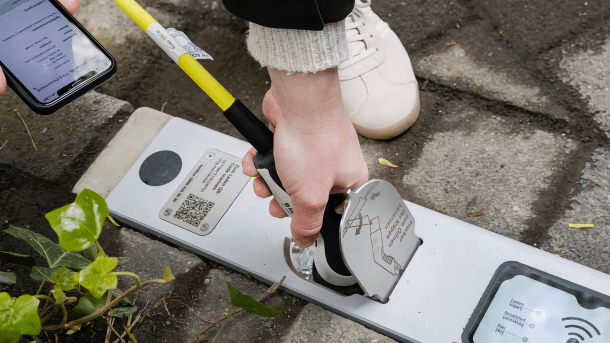
Several tail lifts were tested in Cologne for a year. Now the technology is going into series production, according to the manufacturer Rheinmetall.
(Image: Rheinmetall)
After a year of testing, Rheinmetall's charging curb is now going into series production. Together with the city of Cologne and the Rheinenergie subsidiary TankE GmbH, the technology, and defense group spent a year testing the charging station for electric cars sunk into the ground. The results were positive, as the company announced: The charging curb had been used for 2800 charging processes with an availability of 99 percent and was rated very positively by users.
The charging curb is intended to be an alternative to conventional charging solutions, especially in densely populated inner cities, and to promote the nationwide expansion of charging facilities. It has the dimensions of a standard kerb and does not require any bollards to secure it, ensures clear lines of sight and does not obstruct pedestrian, cycle or road traffic. In terms of installation and maintenance expenses, it is comparable or even cheaper than a conventional station. A few critical voices could be read on the internet, stating that bending down was perceived as negative and that some were disgusted by possible soiling.
Four loading curbs tested
However, the user survey presented by Rheinmetall paints a positive picture: the 100 respondents gave the tail lift an average score of 4.38 out of 5. Older users over the age of 60 and slightly more women than men in particular gave it good marks. Users with limited mobility also rated it as easily accessible.
Videos by heise
A total of four charging kerbs were tested at two locations in the Lindenthal district of Cologne. The station enables a charging capacity of up to 22 kW (AC). During the test period, the utilization rate was 65 percent. On average, there were 2.15 charging processes per charging curb per day and a total of over 50 MWh was charged. The concept for the charging curbs was first presented to the public three years ago.
Initial improvements
Some optimizations had already been made during the tests. For example, the socket area has been better protected against dirt and the lighting has been improved to make the charging station easier to find. This may also counteract the incorrect use by combustion vehicles that has occasionally been observed. An anti-stick coating has also been added, and the metal flaps have been dampened following complaints from residents.
(mki)