


Miniature walking robot: "Lego minifigure" runs over 0.8 km/h fast
A maximum reduced walking robot runs at a speed of 0.8 km/h. This does not require a lot of mechanics.
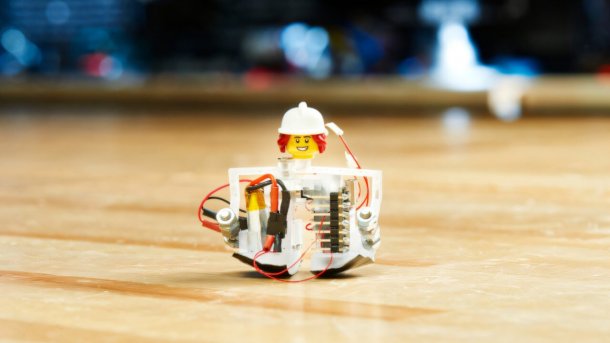
The Zippy walking robot is very fast for its size.
(Image: Carnegie Mellon University)
A research team at Carnegie Mellon University (CMU) has literally given a "Lego minifigure" legs. A two-legged walking robot accelerates to more than 0.8 km/h. The construction, called "Zippy", can walk in all directions, jump and climb small steps.
Micro-robots with legs can move better over rough terrain than those with wheels. The researchers at CMU have therefore investigated how complex walking mechanisms can be simplified in order to construct a simple walking robot that requires little energy. The results of the investigations are to be presented this year at the IEEE International Conference on Robotics and Automation.
Empfohlener redaktioneller Inhalt
Mit Ihrer Zustimmung wird hier ein externes YouTube-Video (Google Ireland Limited) geladen.
Ich bin damit einverstanden, dass mir externe Inhalte angezeigt werden. Damit können personenbezogene Daten an Drittplattformen (Google Ireland Limited) übermittelt werden. Mehr dazu in unserer Datenschutzerklärung.
At just under 38 mm, the Zippy walking robot is smaller than a Lego minifigure measuring around 40 mm. Strictly speaking, the researchers only use the head of a minifigure, which they have placed on the walking robot.
Simple walking construction
The scientists' design is based on research into the larger walking robot Mugatu. Zippy has two rigid legs, rounded feet and only uses an electric motor in its hips to generate movement. The motor is controlled by a conventional microcontroller using an Initial Measurement Unit (IMU) to evaluate the robot's position in space. The robot lifts one leg and shifts its center of gravity forward. The robot then falls forward onto its rounded foot. Then it is the other leg's turn. Weights in the feet support the movement. The rounded feet in combination with weighted arms attached to the sides prevent the robot from tipping over. The robot is powered by an internal battery.
Zippy thus achieves a remarkable walking speed of ten leg lengths per second. This corresponds to just over 0.8 km/h. Converted to an adult human, it would run at a speed of around 30.6 km/h.
The walking robot Zippy is therefore not only the smallest, but also the fastest autonomous two-legged robot in terms of size, says Sarah Bergbreiter, who led the project together with Aaron Johnson.
Videos by heise
Spurred on by the results so far, the researchers want to go one better. They are planning to equip Zippy with sensors and cameras. This should enable it to recognize its surroundings and then navigate independently. The researchers envisage Zippy being used for search and rescue missions in dangerous environments.



(olb)

