


Photo news: Two Lumixes and a dispute over a historical image
Panasonic's S1 II and S1 IIE are finally here, DJI has what is probably the ultimate affordable drone, and the "Napalm Girl" image has an unclear creator.
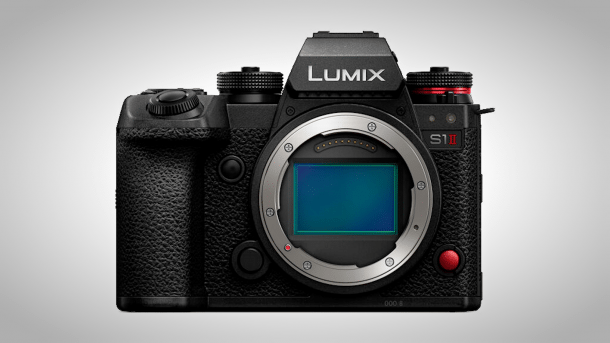
The Lumix S1 II, like the very similar S1 IIE, has inherited the body of the S1R.
(Image: Panasonic)
It took Panasonic almost five years to develop the successors to the S1 and S1 R –, but in between there was a pandemic in which the cameras became increasingly popular, especially among filmmakers. So there was enough time for a retread, and one thing you have to get used to straight away: the "E". The S cameras were previously unfamiliar with this suffix, which stands for "Essential". The S1 II is therefore the higher-quality camera, the S1 IIE the entry-level model. Hence the prices: the bodies cost 3500 and 2800 euros respectively.
Not a huge difference in these price ranges, and even a cursory glance at the technical data does not clearly show the difference. Both cameras work with a 24-megapixel sensor and film in 4K and 6K at 60 or 30 frames per second. But the big difference is that the S1 II has a sensor that is partially equipped with memory and logic (part-stacked) and is therefore significantly faster: 70 instead of 30 continuous shots with an electronic shutter and filming at 5.8K at 60 fps and 4K at 120 fps are possible with the more expensive camera. It is therefore faster in all respects.
Housing of the S1R II
It is to be praised that Panasonic has not cut back on the video functions that are particularly important in the Lumixes in the cheaper camera. Among other things, both models offer various log profiles and recording in Apple's ProRes and ProRes Raw, various particularly wide image formats up to 2.4:1. Two CFExpress B and SD-UHS-II slots should provide sufficient space. No expense has been spared with the weatherproof housing either: it comes from the S1R II. The integrated stabilizer (IBIS) now compensates for eight f-stops, and the AI autofocus recognizes various types of sport and, of course, animals and people. Both models are due to be available from June –, and with a package that is round by the book, they are likely to run out quickly.
Mavic 4 Pro sets standards
This is perhaps not to be feared with DJI's new Mavic 4 Pro drone, as the current customs chaos in the USA means that the flying camera will not be delivered there for the time being. Although even the smallest version with 64 GB of internal memory – Micro-SDs are still supported – is no bargain at 2099 euros RRP, the leap compared to previous generations is enormous: up to 50 minutes of flight time on one battery charge and three cameras, one with 100 megapixels and Hasselblad logo as well as 4K films in HDR are just the biggest marketing arguments.
What is really surprising is the new gimbal, which can rotate the entire camera unit 360 degrees. This is not only useful for portrait format shots with full sensor resolution, but also for camera angles previously unknown with drones. This makes it possible to achieve looks that were otherwise only known from large film productions with remote-controlled cranes. Another clever feature is the optional charger for three batteries, which, among other things, can transfer the remaining capacity of two of the power storage units into one –, giving you the maximum duration of a flight without a stopover. Find out more in our detailed report on the Mavic 4 Pro.
Videos by heise
Provenance of a historical war photo remains controversial
This column is always about the CAI/C2PA digital authenticity seals for press photos, and this week once again showed why they are so important. The long-running dispute about the author of one of the most important press photos of the 20th century has entered a new round. The question to be answered is: "Who took the picture 'Napalm Girl'?" It was not Nick Út, who was previously named, says the World Press Photo organization, covered by Ut's former employer Associated Press (AP). Instead, there are several possibilities, as a recent report shows.
On this day in June 1972, several photographers and camera crews were present when nine-year-old Phan Thị Kim Phúc, who was seriously injured, fled her village following a firebomb attack. The picture stands for the horrors of war like no other, precisely because it does not show any fighting or soldiers, but only the effects on the civilian population.
Despite the heavy subject matter, the PDF analyzing the World Press Photo is our recommendation for a long read at the weekend. Among other things, it explains – unfortunately not very precisely – how the organizations relied mainly on technical investigations such as distances to the subject and the cameras used. This is because, especially after more than 50 years, rough location information and witness statements are not very reliable when it comes to clarifying important questions. So it's high time that in the digital age this was finally recorded reliably at the time of shooting.



(nie)

