


Charm offensive: OpenAI office opens in Munich
Private users are good, companies make money: OpenAI is setting up a small team in Germany to support corporate customers and developers.
(Image: HILLWIRED)
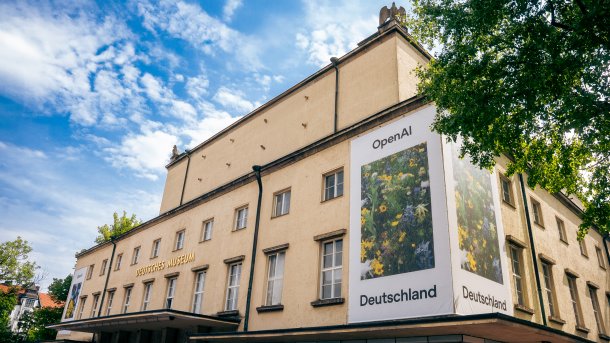
Germany is not as hostile to AI and technology as is often claimed. This is claimed by none other than ChatGPT developer OpenAI, which is opening an office in Munich in view of the opportunities this could bring. The office was inaugurated this week – however, the celebration did not take place at the secret location itself, but at the Deutsches Museum.
Internal evaluations by the Californian tech company apparently raise hopes of flourishing business: not only do most of ChatGPT's paying European subscribers come from Germany. Germany also ranks in the top three worldwide in terms of paying corporate customers outside the USA, and in terms of the number of developers using the API, Germany ranks second behind the USA. The company does not provide concrete figures that would allow an independent comparison or classification.
Thanks to its talent, Germany could even become a European AI pioneer and take on a leading role, Chief Operating Officer Brad Lightcap wooed the invited guests: "Germany is known worldwide for technical excellence and industrial innovation – it is therefore only logical that the country should play a leading role in the introduction of AI." In particular, OpenAI sees enormous potential in working with local developers and corporate and industrial customers, as well as its proximity to the clusters of excellence at the Technical University of Munich.

(Image: HILLWIRE)
Customer consulting, not research
OpenAI employs 2,000 people in 12 offices worldwide. More than 650 of them work in research. There are already European offices in Paris, Brussels, Dublin, London and Zurich. The Munich branch currently consists of ten employees who act as contacts for business customers and provide support in the implementation of specific projects. The local experts are primarily there to help with conceptual or fundamental questions; for example, whether and how an idea could be realized or how to catch the (inevitable) errors of the statistical system in practice in order to limit the damage. Munich is not planned as a research and development location. In this respect, the AI forge seems to prefer Zurich; it poached the machine learning experts Lucas Beyer, Alexander Kolesnikov and Xiaohua Zhai from Google Deepmind for its branch there.
The time to establish small local teams and to find out what makes customers tick in the various markets is favorable in two respects. For OpenAI, 2025 is set to be the year of AI agents that automate processes in companies. The existing ChatGPT function Deep Research, which independently researches topics by analyzing Internet sources, interacting with them and, if necessary, obtaining additional information from the user or writing Python scripts, provides a foretaste of this. At the moment, companies mainly use ChatGPT for simpler tasks such as customer support. With the introduction of agents, AI developers are positioning their models for more complex processes.
The EU is also paving the way. Last year, the European AI Regulation (AI Act) came into force. It regulates the handling of machine learning systems and in particular the basic models (General Purpose AI, GPAI), which include the speech and image generators – ChatGPT, Gemini, Claude, Perplexity et cetera – as well as their multimodal and agentic enhancements. The final version of the Code of Practice for these GPAIs, which sets out mandatory guidelines for the implementation of such systems, is currently being drafted. The code of practice will be published at the end of May and will be binding from August 2.
These guidelines are particularly important for small and medium-sized companies without a large compliance department in order to stay on the safe side legally with AI-controlled processes. Once the final version is available, some German companies that have held back up to now could well initiate more complex AI projects. Product manager Nick Turley told heise online that he is committed to complying with European regulations. Corporate customers can explicitly choose servers with a German or European location and have their company data processed in such a way that it does not flow back into the system for training or other purposes; currently in Microsoft data centers, as Turley explains.
Videos by heise
Human welfare versus business
However, the company also needs to build trust, and for this it will have to be measured more by deeds than words. Developing "general artificial intelligence for the benefit of mankind" – OpenAI continues to carry this leitmotif before it. In the past, however, the promised good cause sanctified some means that were perhaps okay as long as OpenAI was a research start-up and its users did not use ChatGPT commercially: among other things, training the networks with copyrighted material. In addition, the usual business models of US tech companies, which are based on growth and displacement, promote the formation of monopolies or oligopolies and therefore tend to work against the good of society. The "good of humanity" does not come about automatically. It has to be fought for, shaped and defended against covetousness again and again – sometimes with the help of AI, sometimes against it.


(atr)


