


"Impressive intelligence": hawk is helped by traffic light signal when hunting
In one town in the USA, a hawk has taken advantage of complex processes at a road junction to hunt in a way that has never been seen before.
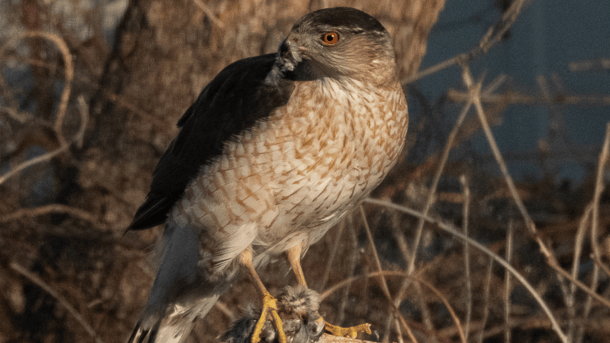
A Cooper's hawk
(Image: Vladimir Dinets)
In the USA, a zoologist has described an “impressive adaptation” of a bird of prey to the particular conditions of a certain road junction, which he interprets as an “impressive” sign of intelligence. The bird in question is a goshawk that has apparently learned that, under certain circumstances, the line of cars at a traffic light intersection becomes long enough to serve as cover for an attack on a group of feeding birds. To do this, the bird had to develop a precise mental map of its surroundings. The case confirms once again that birds of prey can be just as inventive and adaptive as parrots and corvids.
A traffic jam as cover
As Vladimir Dinets from the University of Tennessee explains, the case concerns a single so-called round-tailed hawk and its hunting tactics in West Orange in the US state of New Jersey. There is a particular intersection where there are usually no more than four cars waiting at the traffic lights. However, as soon as someone wants to cross the road on foot and requests a green phase by pressing a button, the red traffic light phase lasts longer, which leads to more cars waiting. At the same time, a signal tone indicates to blind people that they can now cross the road.
Videos by heise

(Image: Dinets)
Dinets has now observed that the bird of prey waited for this sound somewhere in the vicinity and perched in a tree at the end of the road as soon as it sounded. It then waited until there were enough cars waiting to fly close to the ground to a small tree near the traffic lights. There it was then only a few meters away from a front garden on the opposite side of the road, where several birds regularly ate the crumbs that had been thrown down from a family's porch. The bird of prey used the cover of the cars to attack the birds. When the traffic lights stopped making noise the following year and the crumbling family had moved out, the bird of prey also disappeared.
The study that the zoologist wrote about this would be very difficult to reproduce, he admits. At the same time, it fits in with other observations of complicated hunting maneuvers in the animal world. The approach of the initially still young bird shows that it has grasped the connection between the signal and the length of the row of cars and has itself recognized the possibility of using this as cover. The fact that it has a mental map of its surroundings is shown by the fact that it loses sight of its prey as it flies alongside the cars. Such an understanding of human traffic patterns and such exploitation has never been described scientifically before, he writes in the journal Frontiers in Ethology.



(mho)

