


Seagate: AI drives storage demand beyond manufacturing capacity
Soon, the demand for more storage space in data centers is expected to increase so rapidly that it will exceed manufacturers' capacities.
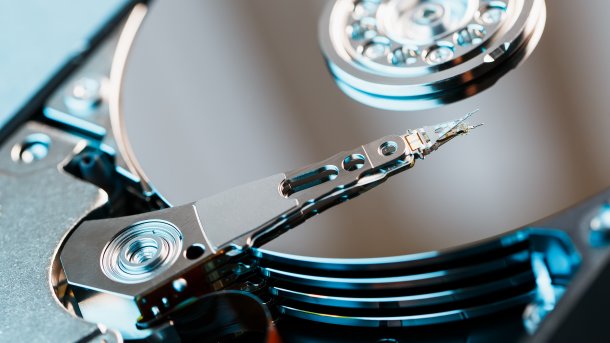
(Image: Aleksandr Grechanyuk / Shutterstock.com)
At the Computex trade fair in Taiwan last week, Seagate presented its analyses and those of market researchers on the future of the hard disk drive business for data centers. According to a projection by IDC, space requirements are set to triple between 2023 and 2028, i.e., within a period of five years.
As the Taiwanese industry medium Digitimes reports, Seagate not only sees good business ahead, the company is also concerned. Soon the space requirements could exceed the manufacturing capacities of the entire industry. At a Seagate investor event held shortly before Computex, the total amount of data generated in data centers in 2020 was 72 zettabytes. By 2028, this figure is expected to reach 394 zettabytes. Seagate cites a study by IDC. One zettabyte is one billion terabytes.
50-TByte disks by 2028
The problem: According to Seagate, the entire storage industry, i.e., Seagate, Toshiba and WD for data center hard drives, has only produced drives with a total capacity of one to two zettabytes per year. Leap innovations would therefore be necessary, but these are not yet in sight. Seagate itself has delivered disks with up to 36 TByte. However, based on the HAMR technology already used there, according to the investor presentation, only drives with up to 40 TByte are to follow by 2026, and then 50 TByte by 2028.

(Image: Seagate)
In the same document (PDF), Seagate also describes how the space requirement is multiplied by generative AI in particular, using the example of a music video. While some generated images require one MByte, the song requires 5 MByte and the video 50 MByte per minute. However, the biggest obstacle to growth for data centers remains the energy supply, as Seagate confirmed in its survey of 300 of its customers with data centers.
Videos by heise
Better encryption instead of shredding
However, because hard disks could become scarce, Seagate wants to focus on recycling more drives, according to Digitimes. According to the company, around 200 million drives are currently shredded every year so that the data stored on them does not fall into the wrong hands. Seagate intends to make this superfluous with new encryption processes at drive level.
Only the keys on the disks should have to be securely deleted – and not the entire capacity, which can take several days for enterprise drives. To this end, the company is working with standardization bodies such as NIST and ISO. Seagate also intends to increasingly return materials from mechanically destroyed hard disks to production.
It should also be mentioned at this point that a kind of gray market has developed around Seagate hard drives that have apparently been in data centers for a long time. Often, refurbished drives have been ending up at reputable dealers for months without being labeled as new. According to the latest information, automated procurement systems are one of the reasons for this. Seagate continues to investigate these incidents, but has not yet issued a comprehensive statement.



(nie)

