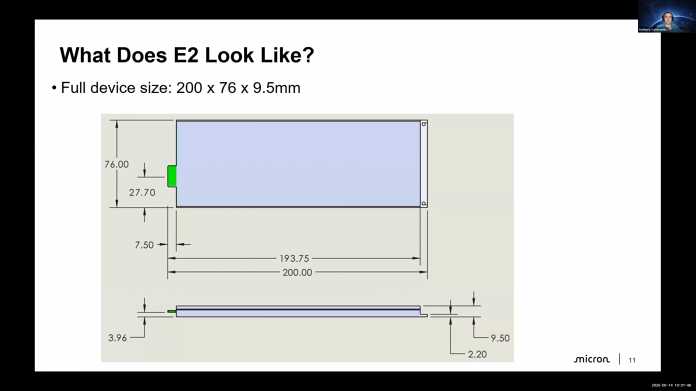
The Storage Networking Industry Association (SNIA) and the Open Compute Project (OCP) are developing a new SSD design for servers. E2 should enable SSDs with a storage capacity of up to one petabyte in the following years. Demand is apparently high, especially among operators of AI data centers.
E2 is a mixture of the previous so-called “Enterprise and Datacenter Storage Form Factors” (EDSFF) E1 and E3: at 76 mm, E2 is as wide as E3, at 9.5 mm as thick as E1, positioned in between in terms of length (200 mm) and uses the standardized status LEDs of E1. While the previous standards still had variants of different lengths, such as E1.L and E1.S, E2 is intended to establish a single version. Those responsible hope that this will reduce product fragmentation.
E2 retains the SFF-TA-1002 connector type and the SFF-TA-1009 pin assignment, and the NVMe protocol will continue to be used. Micron engineer Anthony Constantine emphasizes: “Keep it simple, just change the dimensions of the box”. The presentation recently took place in an OCP session, which is available on YouTube. The E2 part starts at minute 1:51:00.
The E2 board is designed for a large SSD controller, six DRAM modules as a cache, 64 NAND flash modules and numerous capacitors. With 64 chip layers per NAND flash module, 512 TByte capacity per SSD would be possible with today's 2-terabit dies. Upcoming 4-terabit dies will be required for the advertised petabyte.
E2 SSDs should use QLC memory, which writes four bits per cell (quadruple level cells), to optimize costs. For this reason, the designers do not expect excessively high transfer rates, despite the PCI Express 6.0 connection via four lanes: they are expected to achieve 8 to 10 megabytes per second and terabyte capacity. A model with one petabyte would achieve 10 GByte/s.
The size has been chosen so that up to 40 SSDs can fit upright next to each other in a U2 slot with two height units (HE). This would allow up to 40 PByte. The Microsoft engineer involved, Lee Prewitt, believes that data centers will no longer only differentiate between so-called hot storage (fast SSDs, but not so much capacity) and cold storage (slow HDDs, but a lot of capacity) in the future. Warm storage such as the E2 SSDs could come as an intermediate stage.
How the OCP Server imagines E2 SSDs.
(Image: Open Compute Project / Meta)
Micron and Pure Storage have already produced E2 prototypes with capacities of 200 to 300 TByte. The first final specification should be ready in summer 2025. SSDs are not expected to be available for several years.
Empfohlener redaktioneller Inhalt
Mit Ihrer Zustimmung wird hier ein externer Preisvergleich (heise Preisvergleich) geladen.
Ich bin damit einverstanden, dass mir externe Inhalte angezeigt werden.
Damit können personenbezogene Daten an Drittplattformen (heise Preisvergleich) übermittelt werden.
Mehr dazu in unserer
Datenschutzerklärung.