


Report: Meta plans lightweight premium VR glasses for media consumption
Meta is reportedly working on an ultra-light VR headset that is specially designed for media consumption and immersive videos and is set to be launched in 2026.
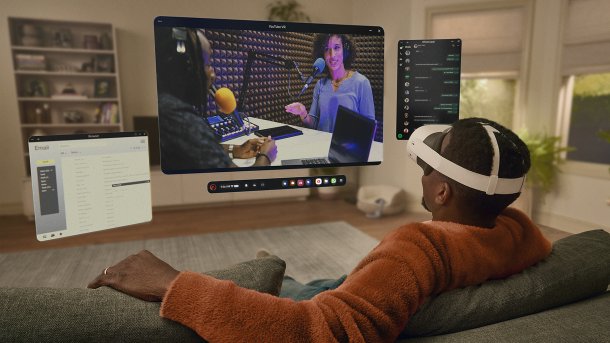
A user watches YouTube and uses the Meta Quest 3S multitasking function.
(Image: Meta Platforms)
The device, codenamed “Loma”, is more powerful than the current Meta Quest and offers better video quality, reports the Wall Street Journal. Externally, it looks more like a large pair of glasses than bulky headsets such as Meta Quest and Apple Vision Pro. The glasses are connected to a small external computing unit that users can carry in their pocket.
According to the business newspaper, Meta is targeting a price of less than 1,000 US dollars for the “premium device”. This would make it significantly pricier than a Meta Quest (from 329.99 euros), but considerably cheaper than an Apple Vision Pro (from 3,999 euros).
Meta has approached Disney, the film studio A24 and smaller production companies, among others, to develop immersive content for the new VR glasses. The company is offering millions for immersive video formats based on well-known brands. It is also negotiating the licensing of existing series and films.
New VR glasses challenge Apple Vision Pro
There have been reports for some time that Meta is working on a new type of ultra-compact VR headset. The tech magazine The Information reported on a prototype that weighs less than 110 grams back in 2024. The low weight is achieved by outsourcing the processor and battery to a wired secondary device.
Meta would thus be following the example of the Apple Vision Pro, which also uses an external element in the form of a wired battery. Meta could also take inspiration from Apple when it comes to controls: According to The Information, the VR goggles are primarily operated by eye and hand tracking instead of controllers. Meta's head of technology Andrew Bosworth later confirmed the existence of such a prototype.
Videos by heise
As immersive media consumption has emerged as one of the most convincing application scenarios for the Apple Vision Pro, Meta's project could be considered a direct attack on Apple – with a device that could be significantly lighter and more compact than the Vision Pro.
Meta has already secured a well-known partner for immersive content: At the end of 2024, the company announced a cooperation with James Cameron's production company Lightstorm Vision. The partners want to produce high-quality, immersive content for devices such as the Meta Quest.
Virtual reality: new form factor, new hope?
The Wall Street Journal report comes at a time when Meta is struggling with declining sales figures for the Meta Quest. In the first quarter of 2025, the company sold fewer devices than in the same period of the previous year – even though the low-priced Meta Quest 3S model was only launched on the market for the Christmas season.
Given this development, it is not surprising that Meta would rather try something new than simply launch another, marginally improved iteration of the Meta Quest on the market. In doing so, the company is tackling the central problem of all VR headsets: the form factor. It remains to be seen what technical compromises Meta will have to make to achieve this.
The fact that Meta is focusing on media consumption for the new device is probably also a reaction to internal data. In March, the company reported that a growing Quest user group sees the VR glasses as an extension of their TV and primarily uses them for media consumption. Meta expects this user group to play a major role in the Meta Quest ecosystem by 2027.
It remains to be seen whether Meta's new VR glasses will actually come onto the market in the form described. It is known that Meta always develops several product prototypes in parallel and can also decide on a different prototype at short notice.


(kbe)


