


Android 16: Beta provides a look at Google's enhanced security program
With Android 16, Google is creating a central point of contact for security settings and expanding the functions of the "Advanced Security Program".
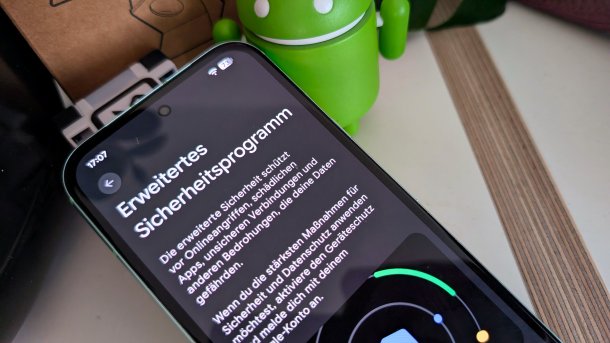
The centralized and extended "Advanced Security Program" will probably only appear with Android 16 QPR 1.
(Image: heise online/afl)
With the update to Android 16, Google has announced a new control center for security functions. However, the centralized "Advanced Security Program" does not seem to be appearing with the stable version that is about to be released, but only with the QPR1 version coming in the autumn. This is because, like the new Material 3 Expressive design, the advanced security functions have only appeared in QPR1.
One button for everything
The "Advanced Security Program" is not completely new, but the functions were previously scattered. With the upcoming update, Google is putting the settings in one place, but also integrating four new security functions. In addition, device protection must be activated by the user. If the switch is flipped in the settings under "Privacy & Security" > "Advanced Security Program", all security precautions come into effect at once. Once advanced protection is activated, these security protocols can no longer be adjusted.

(Image: heise online/afl)
In the new dashboard, the security functions are sorted by categories such as Device Theft, Apps, Networks, Web and Phone app. In the device theft section, the manufacturer informs users that the device will restart after three days of inactivity. This function has been known for several weeks, but it was unclear at the time whether it was part of the optional program.
Videos by heise
Device restart after 3 days
Google explains that the function is intended to protect "lost, stolen or confiscated devices". The explicit reference to "confiscated devices" in particular should make law enforcement officers and courts sit up and take notice. In May 2025, the Federal Court of Justice clarified that the police may unlock a cell phone under certain circumstances by placing a suspect's finger on the biometric fingerprint sensor – even under duress –.

(Image: heise online/afl)
Another new feature is that devices protected in "Advanced Protection" mode are not automatically reconnected to Wi-Fi networks that are deemed insecure. Such networks include those that do not use encryption or only use WEP (Wired Equivalent Privacy) or OWE (Opportunistic Wireless Encryption, for example in public networks).

The advanced security program is aimed at users who are at increased risk from online attacks. However, it can be activated by anyone who wants extra protection for their own data and smartphone. However, you should be aware that the function means it is no longer possible to install apps via sideload, among other things. Google also points out that some websites may not load as expected.


(afl)

