


After a sleepy energy transition, start-ups want to ensure more independence
Various start-ups are working on using electricity more efficiently, tapping into new energy sources and storing it. This requires more investment.
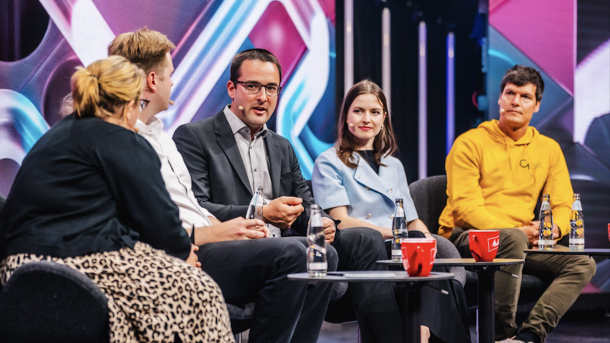
Solveig Rathenow from Business Insider, Jochen Ziervogeln from Enpal, Christian Schmierer from Hyimpulse, Natalie Kreindlina from Kekst CNC and Christian Vollmann from C1 (from left to right)
(Image: Founders Foundation)
Electricity consumption has risen sharply, especially with the spread of ChatGPT, Claude and co. This is why various start-ups are working on using electricity more efficiently and tapping into new energy sources or utilizing it more efficiently. But more is needed to achieve independence in the energy supply and bring more innovations from Germany back onto the market. The panelists at the "Hinterland of Things" start-up conference agree on this.

Christian Schmierer from Hyimpulse, a German aerospace company, explained in the panel "Power Play: How the energy infrastructure is shaping Germany's global technology ambitions" at the start-up conference " how he wants to give the European space industry and the military "access to space" again. Last year, three out of almost 300 rockets were launched from Europe. Last year, the start-up launched a German carrier rocket with kerosene as fuel to great media attention.
Germany ideal location for high-tech
According to Schmierer, production has not been "particularly energy-intensive" so far. However, as soon as it goes into series production, this will change. "We see the problem here with social security contributions and so on, because we need a lot of staff and also skilled workers from abroad [...] But overall, Germany is of course an ideal location for high-tech," says Schmierer. He would like to see reliable framework conditions from the government. The combination of legal certainty and financial stability is crucial for Europe to survive in the international space competition. Once something has been decided, it must also be implemented quickly. Although the government had wanted to rush through a space law, this had fortunately not happened. In addition, a European space law is coming anyway.
According to Natalia Kreindlinda from the communications consultancy "Kekst CNC", the launch and the story behind it are a prime example of how important public awareness is for start-ups, especially in an industry as regulated as the energy sector. This worked well with Hyimpuls because everyone was interested in the "cool rocket" that runs on candle wax.
Christian Vollmann from C1 is calling for the state not to prescribe the solution to a problem, but to invite tenders that are more open to solutions. C1 have set themselves the goal of producing low-cost green methanol, a substance that can be used to fuel container ships and cruise liners. Green methanol should also play a role in aviation (as SAF) and the chemical industry (as a base material for numerous products). This is not just about "green", but also about resilience. "For every tonne that we can produce green methanol from CO₂, we have to import less gas and oil from abroad, and that makes us more independent, even in the event of defense. And the state naturally plays a decisive role here," says Vollmann. Jochen Ziervogel from Enpal, on the other hand, would like to see completely smart electricity grids that communicate with each other. In order to realize this in the future, a joint, solution-oriented dialogue must be conducted.
Videos by heise
Investment in the chip industry in Europe
In order for Europe to have a chance in the semiconductor industry, according to participants in the panel "Reducing dependencies and risks: AI Computing made in Europe", greater investment is needed. Although initiatives such as the European chip law are helping, this is still not enough. In Germany, the largest investments are considered to be a total of 40 billion in the Intel plants in Magdeburg and the planned TSMC branch in Dresden (ESMC), for which the site is still being prepared. According to Sebastian Schall from Black Semiconductor, there is currently a major paradigm shift in computer technology in Europe. "Everyone knows that chips have to be networked differently in order to increase computing power – with optical connections," says Schall. A completely new field is opening up in this area that Europe can serve. This is why investment is needed, according to Aron Kirschen from the start-up Semron, which was founded in Dresden and develops intelligent AI chips. A lot is being invested in the chip industry in the USA.
Energy must remain affordable
The experts at the Hinterland of Things conference agree that the energy transition needs more speed, pragmatism and investment. This is also the central theme of the panel "From energy transition to competitive advantage: scaling clean technologies to secure Germany's industrial future", which was also emphasized: "The energy transition has various components. One is actually energy production. [...] technological leadership in photovoltaics and wind has been lost," said Dr. Hendrik Brandis from the investment firm Earlybirds. Nevertheless, there are "other clean energy production processes that we need", where "leadership [...] is not yet clearly distributed". There are various start-ups in the field of nuclear fusion, four of them in Germany. He mentioned Marvel Fusion, which he said is talking about a laser that "hits the fuel with high energy [in order] to initiate the fusion process".
"There are other candidates for clean energy production, including deep geothermal energy," said Brandis. The third candidate is "orbital photovoltaics, where the main issue is energy transmission and how to bring it back to Earth". According to Brandis, there is "potential for technological leadership in all of these areas, just as we once had in photovoltaics". In addition to methods such as those used by the start-up Greenlyte, which claims to "remove CO2 from the atmosphere and produce green hydrogen in the process", he mentioned the start-up Terralay, which wants to build a cloud platform for the energy market, in the field of energy storage.
Germany should build its own
When panel moderator Uwe Jean Heuser from Die Zeit asked what sets Greenlyte apart from other direct air capture companies, Florian Hildebrand from Greenlyte replied: "We take CO₂ out of the air, clean the air and ultimately create the chemical energy storage system, which can then be used again when the sun is no longer shining, for example." With regard to the energy transition in Germany, there are questions about the structure of energy production on the one hand and the question of how to benefit from value creation on the other. "And if you look at [...] what we do, or all the other companies, there is simply an incredibly high level of added value in plant engineering," said Hildebrand. 60 to 70 percent of the resulting value lies "in plant engineering, in the components and so on. And these still come from Germany today, which is why it is simply important that we show that we are doing it."
Energy transition needs investment
Stephan Segbers from Rheinenergie is certain that with Katharina Reiche (CDU) as Energy and Economic Affairs Minister, there will be a paradigm shift "away from the rather dogmatic energy transition of the last legislative period". Investments must be made in infrastructure and not just in dependence on the current government. Clarity should therefore be created over a much longer period of time. Only then will the energy transition succeed. According to Segbers, it is important to focus more on the energy triangle and the issue of affordability, "but also supply, security and energy self-sufficiency".
When asked about the 100 billion euro investment in climate and agriculture promoted by the Greens, Segbers replied that the funds were also being invested in the development of new technologies, for example "to bring the first prototype of a fusion reactor to Germany [...] it is almost more important at this point to develop the basic technology than to invest even more money in rolling out known technologies, I mean renewables in particular, which simply lose efficiency the further we roll them out". With the energy transition, the grids should also have been better developed and investments should have been made in storage technologies. Regarding this the Minister of Economic Affairs' plan to have gas-fired power plants built again, Segbers explained that it would be a temporary solution as long as no other base-load capable alternatives were available. If it was not to be nuclear energy or coal.
Enthusiasm for renewables is waning among consumers because they are expensive
Segbers is currently observing a decline in enthusiasm for renewable energies, which is linked to the costs. The products have to be economically attractive for customers. "I don't think the green impetus has waned," says Segbers, but the reality has shown that the "energy transition, as we have pursued it now, will become unaffordable at some point [...] We [...] want to subsidize grid fees and the like. This can be done temporarily, but not permanently". The issue of affordability and security of supply must be given priority.
In response to the accusations that traditional energy suppliers like to put the brakes on when it comes to new technologies, Segbers said that at the start of the new millennium. It was often believed that this was just a phase. "And then [...] everyone paid very, very dearly for it, you have to be honest, in purely economic terms, but also morally. And I can no longer see that today," says Segberg. He can no longer see that. He also referred to the batteries with large storage capacity that are currently being developed. All energy suppliers have an interest in advancing the energy transition. For the future, it is important not to focus on just one aspect, because then it will be expensive.
Brandis hopes that in ten years' time there will be a clean energy source alongside renewables. He hopes that the first fusion prototype reactor will be built in Germany. Another hope is to expand large power lines more quickly "to actually distribute renewable energies more efficiently and make them usable". Hildebrand would also like to see faster approvals, for example for the construction of a hydrogen plant in a chemical park. He also believes in independence through decentralized supply with smaller grids. All participants also spoke out in favor of a better storage infrastructure.


(mack)

