


Android 16 is ready: With live updates, but without Material 3 Expressive
Android 16 is ready. The major update will initially be distributed for Google's Pixel devices. However, Material 3 Expressive is still missing.
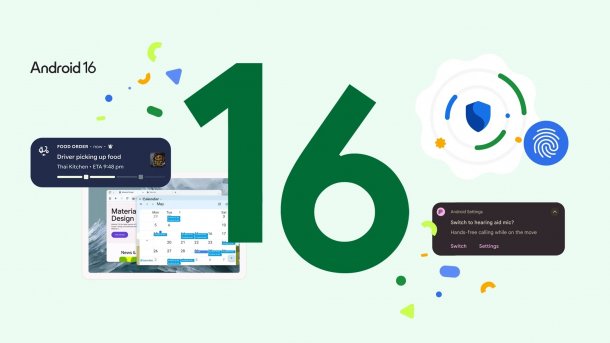
Android 16 is ready.
(Image: Google)
Google released the stable version of Android 16 on Tuesday. The update is initially available for installation on Google's Pixel devices from the Pixel 6 and newer and includes the "Live Updates" function. The new operating system version also introduces the "Advanced Security Program".
Live updates – later also for Samsung and Co.
Initially, live updates will be introduced for carpooling and food delivery apps, according to Google, so that users can follow the progress of the journey or delivery on the lock screen and in the notifications in real time. Later, Google plans to introduce support for Google Maps for navigation. Real-time information on local public transport is also planned.
According to Google, the function will land in the Now bar on Samsung devices with One UI 8 and will be built into the "Live Alerts" on Oppo and Oneplus smartphones, which was introduced with Oxygen OS 15. It is reminiscent of Apple's Dynamic Island. Vivo and Xiaomi are to integrate the function into their respective Android interfaces.

The update also groups notifications that come from a single app to reduce the flood of information.

(Image: Google)
Enhanced security program
Users who attach great importance to a high level of security can activate the "Advanced Security Program" after installing the update. With one click, the device will be protected against "online attacks, malicious apps, unsafe websites, fraudulent calls and more". Many of the functions were already part of Android before, but now Google has brought them all together in one place.

(Image: heise online/ afl)
In the new dashboard, the security functions are sorted according to categories such as device theft, apps, networks, web and phone app. In the device theft section, the manufacturer informs users that the device will restart after three days of inactivity. This function has been known for several weeks, but it was unclear at the time whether it was part of the optional program.
Improvements for hearing aid wearers
Another new feature of the update aims, among other things, to improve call quality for people who use hearing aids with their smartphone.

(Image: Google)
According to Google, current hearing aids with LE Audio use their built-in front microphones for audio input. These microphones are designed to pick up the other person's voice, but not your own. Users can switch to the smartphone's microphone so that their own voice is better understood by the other person when making calls in noisy environments.
Android 16 also introduces a native control for hearing aids, which should make access easier and operation more consistent. Among other things, users can control the volume of the hearing aids directly via the Android smartphone.
Android 16 has also integrated numerous other functions: In addition to support for Auracast, the operating system also supports HDR screenshots, an adaptive refresh rate and resizable tiles in the quick settings.
Videos by heise
Desktop mode and Material 3 Expressive later
However, Google is still holding back two major new features, which will only be distributed in a further update later this year: Firstly, the new Material 3 Expressive design language is still a long time coming. Users of Pixel smartphones can already try it out with the beta of Android 16 QPR1 (Quarterly Platform Release).

(Image: Google)
On the other hand, the desktop mode with window management and other functions announced at Google I/O 2025 will only be included in Android 16 at a later date. Developers can already try out the function with QPR1 Beta 2, according to Google.
Android 16: First for Pixel 6 and newer – Samsung and co. to follow soon
As is usual for Android releases, Google is initially delivering the new update for its Pixel models from the Pixel 6 and newer. The Pixel foldables and the Pixel tablet will also be supported.
Samsung – is expected to begin launching the first Galaxy devices with One UI 8 based on Android 16 in July, starting with the Galaxy Z Fold 7. Samsung is also already offering a beta version for the Galaxy S25 smartphone series, which is expected to be extended to other models.


(afl)

