


SAS: With the Unreal Engine to a more efficient industry
SAS now also offers extensive support for the creation of AI agents. There are also further aids for software developers.
(Image: SAS / Screenshot)
- Harald Weiss
SAS has presented its further AI strategy. The innovations are essentially extensions to the Viya platform. The focus is on the creation of AI agents, support for software development, the generation of synthetic data and improved visualization for digital twins. In addition, a preconfigured solution for medium-sized companies is now also available.
In detail, the following improvements have been made: The Intelligent Decisioning module now facilitates the development and provision of intelligent AI agents for automatable decision-making processes. SAS emphasizes that the solution represents “a balance of autonomous AI and human judgment, balancing complexity, risk, and business objectives”. The new Viya Copilot is comprehensively equipped. It is aimed at developers, data scientists and specialist users and enables a wide range of analyses and is designed to accelerate business processes. The Copilot is based on Azure AI Services, which is the result of a collaboration between SAS and Microsoft.
The Viya Workbench is primarily of interest to developers: this is a cloud-based IDE that can also generate code independently. Workbench has been on the market since the end of 2024, but has now been significantly expanded. It can be used to quickly create models in Python, Visual Studio or Jupyter Notebook. Workbench also supports R and its Enterprise Guide can also be used as an optional integrated development environment. The Workbench is available on AWS and Azure. The new Data Maker, which is based on the acquisition of Hazy last year, generates synthetic data in compliance with data protection or other regulations, such as those that exist in the healthcare sector, in pharmaceutical research or in public administration. Viya Essentials is now available for SMEs. They are fully managed by SAS, meaning they are ready for immediate use and are designed to lower the barrier to entry for AI.
Digital twin: simulating through play
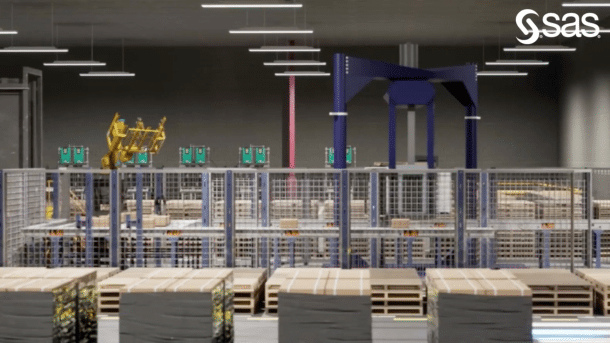
An increasing problem with complex digital twins is that too much information appears on the screen at the same time for large systems or buildings, and relevant data is difficult to recognize. This can lead to incorrect decisions and undermine trust in the twin. In the solution now presented, SAS uses the Unreal Engine from game manufacturer Epic Games to generate a realistic 3D output of the simulation.
Videos by heise
The SAS showcase project is already running at Georgia Pacific, the world's largest manufacturer of paper and cellulose-based building materials. It is using the new solution in the 400 m long Savannah River Mill production facility, which has a complete digital twin. In addition to production, this also includes the entire warehouse with all automated guided vehicles (AGVs). Such production environments, in which people work alongside autonomously controlled vehicles or robotic forklift trucks, are very complex. And if something goes wrong, it can not only be expensive but, in the worst case, can also injure people. On the other hand, experience has shown that it is precisely this complexity that offers great potential for productivity improvements and cost savings.
The first task that the new system had to solve in this respect was the optimal use of AGVs: what are the benefits of using more vehicles in terms of overall performance in relation to acquisition and maintenance costs? Vehicles were added or removed by drag & drop and various loads were set. The result was surprising: more systems make the overall logistics performance less productive because it leads to congestion. To improve the system's performance by eight percent, the fleet size even had to be reduced from 50 to 47 AGVs. This means more performance with less effort. Results like these encourage the two providers to do more. They are already planning to use the system in large-scale plants such as refineries, in hospitals or in the development of smart cities.
More information on all the innovations for Viya can be found at SAS.


(olb)


