


Detector in the Antarctic receives mysterious signals
A detector hovering over Antarctica has recorded two signals that cannot be explained by the standard model of particle physics.
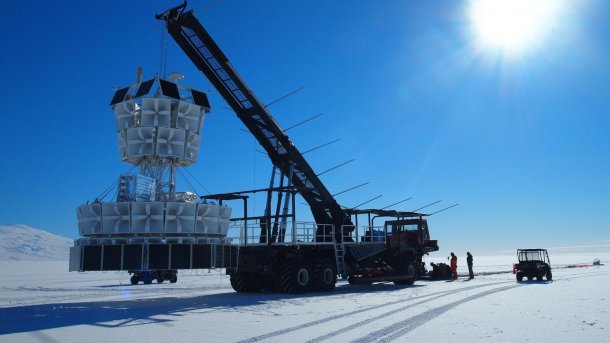
ANITA is being prepared for the launch
(Image: Stephanie Wissel / Penn State)
Is this the beginning of exotic physics? Physicists are puzzling over two signals picked up by a detector in the Antarctic. They cannot be explained by the standard model of physics.
The signals were detected by ANITA. The instrument records radio signals that are generated when neutrinos or other high-energy particles from space interact with the Earth's atmosphere or the subsurface.
“The radio waves we detected came from a really steep angle, about 30 degrees, below the surface of the ice,” said Stephanie Wissel from the ANITA team. If the signals came from neutrinos, they would have had to have passed through the Earth, around 5700 kilometers. However, no particle of the standard model would have survived this.
In addition, the two signals were very energetic: 0.6 exaelectronvolts (EeV) – which is about 200 times more than previously detected signals. The researchers are puzzling over the origin of the signals: “This is an interesting problem because we still have no explanation for these anomalies,” said Wissel. “But we do know that they very probably don't come from neutrinos.”
Neutrinos hardly interact
Neutrinos are electrically neutral, largely massless particles. They move at almost the speed of light and almost never interact with atoms. For example, they can pass through the earth more or less unhindered.
Huge instruments are required to detect the signals of neutrinos. ANITA, an abbreviation for Antarctic Impulsive Transient Antenna, is an array of antennas suspended from a helium balloon. It rises above the Antarctic and travels for about a month at an altitude of around 40 kilometers in circumpolar winds over the Antarctic.
“We point our antennas at the ice and search for neutrinos that interact with the ice and generate radio emissions, which we can then record with our detectors,” explained Wissel. There have been four ANITA campaigns to date, the first in 2006 and the last in 2016. The signals in question were detected on the first and third flights.

Other neutrino detectors include IceCube in the ice of Antarctica and the European observatory Cubic Kilometre Neutrino Telescope (KM3NeT), which currently consists of two large sensor fields in the Mediterranean.
Other detectors recorded nothing
The team compared the data with that from the Pierre Auger Observatory, as reported in the journal Physical Review Letters. However, this did not register anything that would have explained the ANITA signals. This also applies to the IceCube experiment.
The signals do not fit into the standard model of particle physics. The researchers describe them as anomalous. According to Wissel, this means that the particles that caused the signal were not neutrinos. It may be an indication of dark matter.
She suspects that there is an interesting effect in the radio propagation near the ice and near the horizon that is not yet understood, Wissel said. For the moment, this remains a mystery.
Videos by heise
A new detector should be available in the future: Payload for Ultrahigh Energy Observations (PUEO) is to ascend like ANITA on a helium balloon in the Antarctic. With this more sensitive detector, “we should be able to detect more anomalies,” said Wissel. “Perhaps we will then also understand what they are.”


(wpl)

