


25 years of "Deus Ex": Do what you want!
Cyberpunk, transhumanism, dystopia – Deus Ex already addressed these topics 25 years ago. The shooter also set the tone in terms of gameplay.

(Image: Eidos Interactive)
Ion Storm was a cursed company. Built on a dream called “Design Is Law”, the developers around John Romero and Tom Hall tried everything to create perfect gaming experiences – by throwing money at solid ideas until they suffocated underneath. With results such as the first-person shooter “Daikatana” (overambitious, overloaded, superfluous), the action role-playing game “Anachronox” (very entertaining and clever, but developed with remarkable consistency that missed the market), and the real-time strategy game “Dominion: Storm Over Gift 3”, which nobody really wanted to touch apart from its creator Todd Porter.
If there was a good side to the tragic story of the company's rapid rise and even more rapid fall, it was the founding of the subsidiary “Ion Storm Austin”. Under the leadership of Origin and Looking Glass veteran Warren Spector (and an emotionally safe 200 miles away from the madness of the main company), a dark classic was created that would change the action and role-playing game genre for all time: “Deus Ex”, which went on sale 25 years ago.
Complete freedom
A “Deus Ex Machina” is a device from dramaturgy, a sudden, unexpected twist in a story where a seemingly out-of-nowhere event or super-competent character appears to solve a problem that previously seemed unsolvable. A panacea for lazy writers, if you like, because it offers a quick solution to a serious problem and thus tends to weaken the internal logic of the plot. A “god from the machine”, as the direct translation of the expression goes.
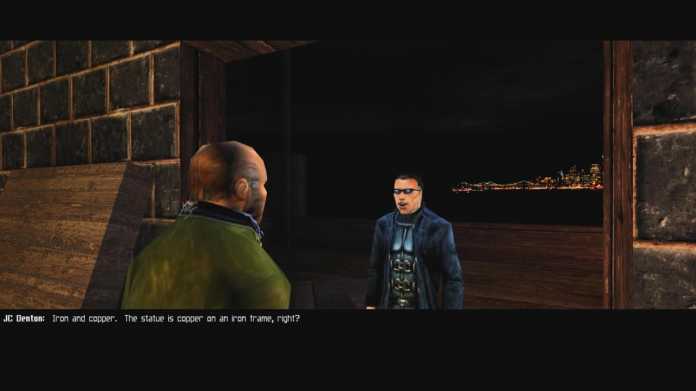
25 Jahre "Deus Ex" (14 Bilder)
heise online
)If you exclude the “machina”, you not only confuse many non-Latin speakers (“I'd like to have djuuu sex” was just one of the phrases you heard a lot in games stores in 2000), but you also have a game that stubbornly refuses to be pigeonholed into a typical genre. Because as Warren Spector has already stated on several occasions: he is simply not the type to hand his players a shotgun, pat them on the back and leave them alone with the hordes of hell. Instead, he sees it as his duty to give the players all kinds of tools and let them decide for themselves how they want to proceed. This was already the case in the 1994 hit “System Shock”, which he produced, but was then taken to perfection in “Deus Ex”.

Because here there is no one right approach, no one correct path to the goal. Instead, each problem offers several possible solutions, all of which have a corresponding effect on the further course of the game. Do you take out your opponents loudly (and risk being shot at) or do you take them out with a well-aimed tear gas grenade and strategic use of the rubber truncheon? Do you choose the direct route or do you improvise a ladder from tables and crates to reach a ventilation shaft that allows you to sneak around?
Videos by heise
Of course, you can solve any problem with a machine gun or a laser sword in your hand. But you can avoid it – or even hack it out of the world with the appropriate skill by penetrating security systems and deactivating surveillance cameras and automatic firing systems. This unexpected (and for the year 2000 still very unusual) degree of playful freedom then logically led to three very different endings, which of course benefited the replay value of “Deus Ex” enormously.

