


DJI drones are slowly disappearing from US shelves
Things are not going well for DJI in the USA. Drones from the Chinese manufacturer are officially difficult to obtain due to various government measures.
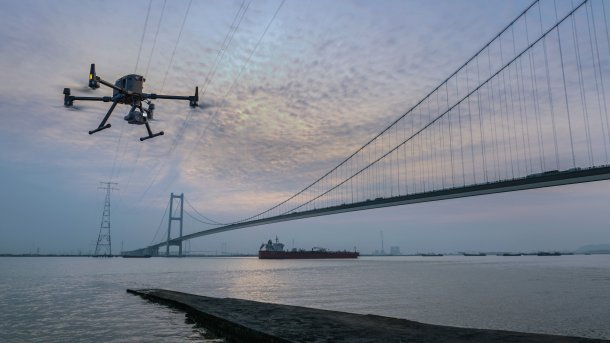
A DJI drone helps inspect a bridge.
(Image: DJI)
The US government's regulatory measures against the Chinese drone manufacturer DJI are having an increasing impact. The shelves with DJI drones are becoming increasingly empty in the USA. DJI no longer even offers one of its latest drones, the Mavic 4 Pro, on the US market.
DJI drones have a market share of around 85 percent in the USA and are used by everyone from amateur pilots to government agencies. The drones have several advantages: The latest technologies are built in, they are robust, and they are comparatively cheap to buy.
However, the US government has wanted to severely restrict the use of DJI drones in recent years. The reasoning: The flight data and footage recorded by the drones could be passed on by DJI to the Chinese government and then analyzed by intelligence agencies. This would compromise US national security. DJI has denied this and, for its part, installed functions such as Local Data Mode and established compatibility with third-party software to avoid the US accusations. However, without effective success. The US government has gradually implemented measures to exclude DJI drones from military and some federal agency applications. These include, in particular, various regulatory and legislative measures.
US authorities make access to the US market more difficult
Recent developments include the Uyghur Forced Labor Prevention Act (UFLPA) and the National Defense Authorization Act (NDDA) to make it more difficult to bring DJI drones into the US. The UFLPA of the U.S. Customs and Border Protection (U.S. Customs and Border Protection – CBP), for example, stipulates that goods that are produced in whole or in part in the Xinjiang region or by specially registered companies using forced labor by Uyghurs, a Turkic-speaking minority in China, may no longer be imported into the USA. This also includes DJI drones, at least according to the CBP, which banned DJI drones from the US market for the first time at the end of 2024. However, DJI is not on the UFLPA list of the Department of Homeland Security. DJI has also denied that its drones are manufactured using forced labor. Production takes place exclusively in Shenzhen and Malaysia. DJI wants to avoid further import incidents in the future and has announced its intention to work closely with the CBP.
The NDDA is intended to protect the military and federal authorities from Chinese drones. It provides for a formal security review of DJI platforms by the end of 2025. If it has not been passed or completed by then, DJI will automatically end up on the Federal Communications Commission's (FCC) “Covered List”. Companies listed on this list will be denied access to the bandwidths managed by the FCC. In practical terms, this means that these drones are then excluded from the US market.
Videos by heise
Existing measures are already having an effect: DJI's US online store is currently empty. Many drones are marked “Out of Stock”. Other US retailers, including Amazon and Best Buy, also have hardly any stock of DJI drones left. They are complaining that supplies are no longer arriving, even though DJI has not officially exited the US business.
DJI has not even launched its new flagship drone, the Mavic 4 Pro, on the US market. DJI justifies this with customs policy uncertainties, such as high import duties, as well as controls and political uncertainty. All of this would make it financially and logistically difficult to import the Mavic 4 Pro into the USA.



(olb)

