


NAS enforcement: Synology charges huge sums for SSDs with outdated technology
Three SSDs from Synology's SNV5400 series have arrived on the market. The company wants to force their use in its NAS.
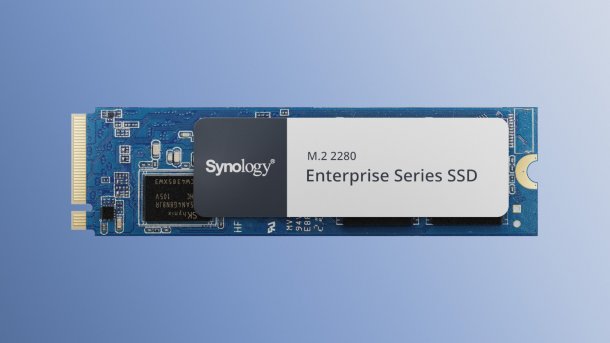
(Image: Synology)
Synology is marketing three new SSDs with capacities from 400 GByte to 1.6 TByte. The SSDs from the SNV5400 series are certified for use in new Synology network-attached storage (NAS) such as the DS925+. Officially, only such certified drives run as mass storage in the new NAS; alternatives work with tricks. In the case of cache SSDs for accelerated caching of data, it should be sufficient to click away warning messages.
If you would rather not circumvent Synology's software lock using tricks, you will have to dig deep into your pockets for the official products: Depending on the SSD capacity, the terabyte prices range from around 390 to 520 euros. Even the 400 GByte model costs more than 200 euros. The price triples for 1.6 TByte.
A look at the USA shows that the dealers have not diced up the prices. B&H Photo is an authorized Synology dealer and charges similar US dollar prices.
Slow with PCIe 3.0
Despite the high prices, the technology is outdated: The M.2 SSDs only support PCI Express 3.0 x4. The first PCIe 3.0 SSDs appeared back in 2014 – since then, much faster successors with PCIe 4.0 and 5.0 have become ubiquitous.
According to Synology, the maximum sequential read rate of the SNV5400 series is 3 GByte/s. The write rate ranges from a low 650 MByte/s to 1 GByte/s, depending on the capacity. With random accesses, the 400 GByte model only manages 225,000 IOPS reading and 45,000 IOPS writing. The 1.6 TByte variant achieves 660,000 and 120,000 IOPS respectively.
Depending on capacity, the five-year warranty covers write performance of 700 to 2900 TByte (Terabytes Written, TBW).
Videos by heise
Power loss protection
On the plus side, there is protection against power failures: In the Synology NAS, SSDs are intended as a data cache to the slower hard disks. Capacitors on the M.2 board ensure that in the event of a power failure, there is still enough power to back up cached data (Power Loss Protection, PLP). This is useful for users who are constantly writing important data to a NAS.
The DS925+, for example, only fits 80 mm SSDs. Although the range of corresponding models with power loss protection is limited, there are significantly cheaper alternatives. It starts at around 170 euros per TByte of storage. iStorage sells PCIe 4.0 SSDs with PLP, which are significantly faster than those from Synology.
If you can do without PLP, you can get SSDs with PCIe 3.0 and PCIe 4.0 as well as one TByte of storage space for less than 55 euros.
Synology has been selling M.2 SSDs without PLP under the type designation SNV3400 since 2021, but they are also overpriced. In the price comparison, they are listed as the SNV3000 series.
In a statement, Synology comments on the technology and pricing of the SNV5400 series. According to the statement, the manufacturer opted for PCI Express 3.0 “in favor of compatibility, stability and a reasonable price-performance ratio”. “Many of our existing systems, especially in the SME sector, were developed with a performance and thermal design that is not designed for the higher requirements of Gen 4 or Gen 5 SSDs,” it says.
Synology justifies the high costs with an enterprise focus: "Our SSDs are specifically validated for professional use in continuous operation and meet requirements that go far beyond those of classic consumer SSDs. These include long-term load tests, predictive failure analysis, consistent behavior under high load and full integration into the DSM ecosystem."
Originally, the article stated that Synology restricts the range of functions in new NAS when using non-certified drives. According to Synology, this applies to the main mass storage and not to cache SSDs. We have updated the article accordingly.
Empfohlener redaktioneller Inhalt
Mit Ihrer Zustimmung wird hier ein externer Preisvergleich (heise Preisvergleich) geladen.
Ich bin damit einverstanden, dass mir externe Inhalte angezeigt werden. Damit können personenbezogene Daten an Drittplattformen (heise Preisvergleich) übermittelt werden. Mehr dazu in unserer Datenschutzerklärung.


(mma)


