


Why augmented reality is treading water
What is holding augmented reality back? AR pioneer Kharis O'Connell has turned his back on the technology and talks openly about his disillusionment.
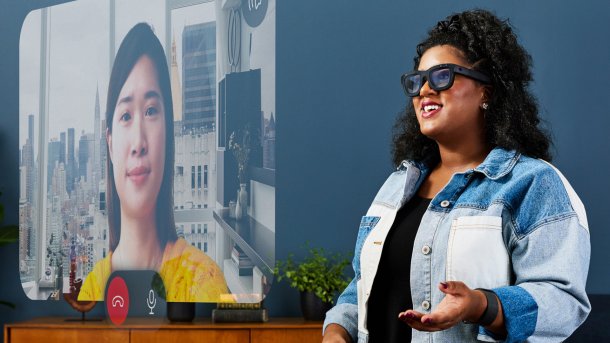
Illustrative image of a video conference with Meta's AR glasses prototype Orion.
(Image: Meta)
Virtual and augmented reality came with a big promise. The new computer platform was to enable a spatial interface and natural operation using gestures, gaze, and voice input. And thus fundamentally change the way people use computers.
However, the established input methods have changed little to this day: Mouse, keyboard and classic screens continue to dominate in the workplace, while the touchscreen of smartphones and tablets dominate when out and about.
AR pioneer Kharis O'Connell is not surprised by this. In a podcast, the dropout describes his unvarnished view of the industry and talks about things that are often taboo in the AR bubble.
Spatial computing: evolution instead of revolution
O'Connell can look back on a long career in the AR industry. He developed the first AR applications for mobile devices back in 2009 at Nokia. In 2017, he became Head of Design at AR start-up Meta, years before Facebook acquired the name. This was followed by a period at Google, where O'Connell designed an operating system for AR glasses. After a stint at Amazon and several start-ups, he has since turned his back on the AR industry and now works for a digital pharmaceutical company.

His happiest time was at the visionary AR start-up Meta, recalls Kharis O'Connell in the latest episode of the tech podcast Dream Machines. The company developed an AR headset with a spatial interface and gesture control, an early form of spatial computing. Meta was way ahead of its time and failed due to the technological feasibility of its vision. In 2019, the start-up had to file for bankruptcy and sell parts of its technology.
According to O'Connell, spatial computing “died” with Meta and never came back in the same form. The AR pioneer criticizes companies such as Apple, Google and Meta, which he believes are not thinking radically enough about the concept. Even Apple's “spatial computer”, the Vision Pro, remains stuck in established paradigms. According to O'Connell, simply projecting iPad apps in front of the eyes misses the point of the entire medium.
Videos by heise
Even if he is oversimplifying at this point, it can still be said: Devices such as the Apple Vision Pro will not replace work computers any time soon and will not fundamentally change the way we work. Although the headset allows any number of windows to be placed anywhere in the room, in the end they will remain windows. You still need a mouse and keyboard to work productively. So we are still a long way from a real computer revolution.
What problems does augmented reality actually solve?
O'Connell moved to Google in 2018. After the Google Glass debacle and the discontinuation of the VR platform Daydream, Google was just about to make another attempt in the field of computer glasses. In the labs, O'Connell came across AR technology that he would never have dared to dream of before. The real challenge was to turn it into a product that solved real-world problems.
As it turned out, the use cases discussed internally were anything but new. They were more or less the same use cases as Google Glass, which were rehashed for Google's upcoming smart glasses in 2025.
Empfohlener redaktioneller Inhalt
Mit Ihrer Zustimmung wird hier ein externes YouTube-Video (Google Ireland Limited) geladen.
Ich bin damit einverstanden, dass mir externe Inhalte angezeigt werden. Damit können personenbezogene Daten an Drittplattformen (Google Ireland Limited) übermittelt werden. Mehr dazu in unserer Datenschutzerklärung.
“Those use cases in today's Google demos, I can tell you, are the use cases I worked on. And those are the use cases I was given from the prior generation of people who worked with it. Nothing has changed,” says O'Connell.
His criticism doesn't just apply to Google, it's an industry-wide problem. AR map navigation, displaying smartphone messages in the field of vision, visual cooking aids: The application scenarios repeat themselves with every new generation, with every new attempt. These concepts might have so far failed because the technology was simply not yet fully developed. At the same time, augmented reality still seems to be looking for issues that it can solve.
Trapped in the echo chamber
O'Connell left Google in 2021, allegedly because the company had once again withdrawn from the AR sector. The idealist O'Connell became disillusioned with the fact that profits were more important than long-term visions and the desire to improve the world with technology. Or as his superior put it in a confidential conversation: Google didn't care whether AR and VR were the future, they were nothing more than a rounding error for the business result.
Tech companies that cultivate on-off relationships with technologies and burn out talent in short-term projects: the history of virtual and augmented reality is full of them. O'Connell's time at Google contributed significantly to his disillusionment and his exit from the AR industry a few years later.
Empfohlener redaktioneller Inhalt
Mit Ihrer Zustimmung wird hier ein externes YouTube-Video (Google Ireland Limited) geladen.
Ich bin damit einverstanden, dass mir externe Inhalte angezeigt werden. Damit können personenbezogene Daten an Drittplattformen (Google Ireland Limited) übermittelt werden. Mehr dazu in unserer Datenschutzerklärung.
O'Connell himself describes his departure as salutary. His life outside Silicon Valley opened his eyes to his obsession with technology, the echo chamber in which he and like-minded people had been living for years, and the resulting conviction that the breakthrough of the new computer platform was inevitable. Today, he no longer believes that people outside the tech bubble really need augmented reality.
As far as the technological hurdles are concerned, O'Connell is convinced that they can be overcome one day. In his view, another question is crucial: who wants this technology in the first place, and what are they prepared to give up for it? What data, what freedoms? Because a technology that sees and hears everything we do will not come without a price, says O'Connell.


(dmk)

