


Receive the European Football Championship without delay
Germany's women's team kicks off the Euros today. Want to cheer from your garden? You'll need low-latency reception—we've measured the best streaming options.

(Image: Ulrike Kuhlmann/heise Medien)
Just in time for the German national team's first match at the European Women's Football Championship, we took a look at the latencies. We are talking about the delays that occur on the transmission paths to the home screen. From July 2 to 27, 2025, 16 nations will compete against each other in Switzerland, with ARD and ZDF showing all 31 matches of the Women's European Championship 2025 live.
The German women will take to the field for the first time on Friday, with the European Championship final taking place on July 27 at 6 p.m. in St. Jakob-Park in Basel. On the first two match days, we measured on which playback channels the delay in TV reception or streaming was the shortest during the soccer matches.
Sat, cable or aerial
For TV reception via tuner, we checked who was ahead this year for the HD signal in the first and second channels. While we were surprised to find that digital cable television (DVB-C) took the lead for the 2024 World Cup, satellite reception (DVB-S2) is once again ahead this year, as usual. But only so close that it was not really measurable: as comparison photos showed, cable television is a maximum of half a second behind the satellite signal.
Latenzen zwischen DVB 2025 (2 Bilder)
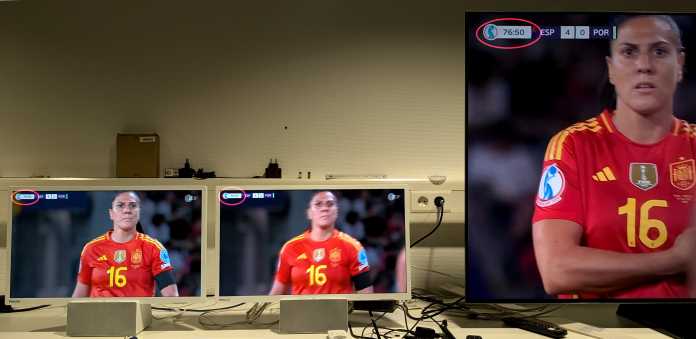
As in the previous year, terrestrial television DVB-T2 was one and a half seconds behind the fastest reception channel. For cost-effective and convenient "cabling" in the garden – simply connect a stub antenna to the large smart TV – and you can just about accept a delay of 1.5 seconds compared to DVB-S2. After all, it is crucial that the neighbors do not cheer and hoot when a goal is scored while the ball is still being positioned on the penalty spot on their own screen.
The public broadcasters ARD and ZDF transmit their programs in high-definition quality via DVB-T2 at no extra cost. However, the signal is not broadcast everywhere. You can find out whether you can receive the terrestrial signal at home with the DVB-T2 reception check on the Internet. "Unsmart" devices such as projectors or monitors can be made fit for terrestrial television with a small DVB-T2 receiver.

Media libraries and browsers
If you don't have a TV connection and don't live in a DVB-T2 reception area, you can watch ARD and ZDF soccer matches in high resolution via the media library apps. To do this, you need a smart display with apps or a dumb one (monitor, projector, old TV) and a streaming stick.
When streaming via the media library apps, ZDF surprised us with latencies of just over 1 second in the normal program and only 2 seconds when streaming soccer matches. ARD's media library lagged far behind here at 10 seconds (7 seconds without soccer) – This is unusable for live events. It is possible that something will change with the first match of the German women's team, which we will update if necessary.
On the smartphone, the latency in the ARD app was reduced to 6 seconds, which is still too long; instead, you should start the live stream in the browser, which lags behind by around 4 seconds. Caution: If you are not in the WLAN when streaming, you should reduce the resolution or quality and thus the amount of data, otherwise your monthly online budget will quickly be used up. In the ARD app, you can access the settings via the three dots next to the playback bar, in the ZDF app via the wheel on the right below the bar.
While the soccer live stream in the ZDF media library app on the smartphone was only delayed by a good 2 seconds, the live stream in the browser lagged a little more at 4 seconds. ZDF has obviously invested a lot in its new media library app; in future, it will no longer be advertised as a media library, but as a streaming portal.
Videos by heise
Streaming services
We also used the widely used FireTV stick from Amazon for streaming, which is simply plugged into the HDMI input of the display or projector and offers "Live TV" in its interface. Without the soccer broadcast, the latency here was 3 seconds for ARD and only 1 second for ZDF (again measured against the fastest reception via satellite). During the soccer broadcast, it was a long 7 seconds for ARD on Wednesday and 3.5 seconds for ZDF on Thursday.
Other streaming apps from Waipu.tv, Zattoo & Co. can be found on the FireTV stick and on smart TVs. We only measured these as examples because the services were so far behind TV reception in the past that extensive measurements were not worthwhile. This also appears to be the case this year: The aforementioned Waipu.tv and Zattoo services were over 20 seconds behind satellite reception. Soccer fans can only tolerate such a delay in soundproof rooms.

(uk)


