


Ruling: Authorities may sell confiscated crypto assets if necessary
Cryptocurrency tokens seized during a criminal investigation can be sold to preserve their value – even against the will of the presumed owner.
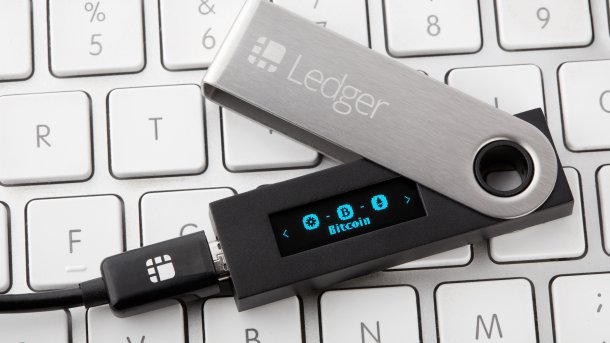
A so-called ledger stick that acts as a physical wallet for cryptocurrencies.
(Image: Shutterstock)
The Hanau Regional Court has clarified that authorized authorities can directly utilize seized crypto assets such as bitcoins in criminal proceedings, i.e. in particular sell them. This also applies if the alleged owner strictly rejects such an "emergency sale" because he is banking on the price increasing. This is the tenor of a recently published decision by the second instance on April 15 (case reference: 1 Qs 10/25). For the prosecution authorities, it is therefore crucial that the current value is maintained due to the expected price fluctuations and potential losses.
The case concerns the seizure of assets as part of an investigation into money laundering against the mother of a convicted drug dealer. The authorities seized crypto assets, physical crypto wallets, so-called ledger sticks, stored in the currencies Ripple and Cardano Blockchain. The son, who was convicted of drug trafficking and is in prison, objected to their planned emergency sale. He claims to be the legal owner of the tokens. He cited their alleged legal origin and the potential for future, possibly significant increases in value.
The public prosecutor's office, on the other hand, argued that the typical volatility of cryptocurrencies entailed an imminent loss in value. It considered a sale to be justified in accordance with Section 111p of the Code of Criminal Procedure (StPO). Accordingly, a confiscated item can be sold if there is a risk of spoilage or a significant reduction in value.
Price prediction difficult in view of global events
In February, the Hanau Local Court initially rejected the application of the person concerned as unfounded at first instance. An economically minded owner without a high risk appetite would therefore decide to sell the crypto assets due to the feared fluctuations in value. A reliable forecast of a stable value or an increase in value is also not possible in view of the fast-moving world politics.
The district court shares this assessment. According to the court, the public prosecutor was right to point this out: A safe prognosis that the tokens would remain "tradable" and thus "realizable" in the long term could not be made. By converting them into a conventional currency, the confiscated amount could be "secured sustainably and without risk of loss of value". Unlike in the case of cars or real estate, there are "no established principles of experience" for crypto assets.
Videos by heise
Prosecutors are not asset managers
The 1st Grand Criminal Chamber also has "profound concerns" that judges or prosecutors would have to constantly monitor such a digital asset, which is subject to intense market dynamics. They do not have a stock exchange department and do not monitor the market expertly with staff or technical applications. Particularly in the case of Ripple and Cardano, price weaknesses are decisive for the legal assessment as a latent risk, whereas a potential "rally" is not.
Criminal law expert Jens Ferner regrets that the decision, which goes beyond the individual case, would squander assets according to the motto "sell what you can". He believes the legislator is called upon to clarify unresolved normative issues. As long as the protection and exploitation of digital assets is not codified in a well thought-out manner, the practice will remain "dependent on creative but legally shaky bridging solutions".



(mack)

