


Virtual reality in the 90s: how the first VR hype started in arcades
Virtuality came before Oculus & Co.: How a British start-up popularized virtual reality and failed due to technology, home consoles and the zeitgeist.
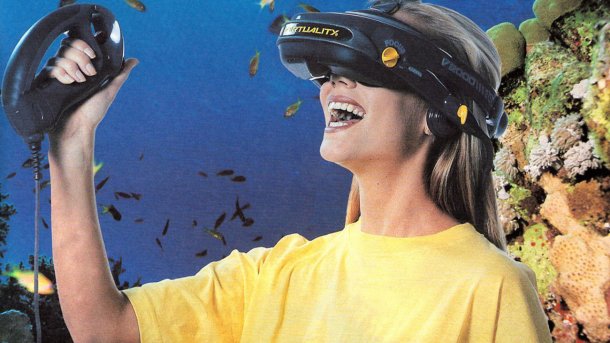
Virtuality took the arcades by storm in the nineties. But the first VR hype did not last long.
(Image: Dr. Waldern/Virtuality Group - Dr. Jonathan D. Waldern, CC BY-SA 4.0)
The virtual reality wave of the early 1990s was not triggered by the big tech companies from the USA but by a small British start-up. Long before virtual reality found its way into living rooms, it could be found in amusement arcades – with huge devices, thick cables, and clunky VR goggles. Virtuality was responsible for this.
Virtuality Inc. was founded in 1987 in Leicester, England, by computer scientist and HCI researcher Dr. Jonathan D. Waldern, who had previously conducted research into interactive 3D systems and stereoscopic displays. Just one year after its foundation, the company, which was still called “W-Industries” at the time, won an innovation award from the British Technology Group. The prize money of 20,000 pounds financed the development of a VR prototype, which soon attracted investors.
Virtual reality becomes a hit in amusement arcades
As early as 1990, W-Industries presented the first publicly accessible VR machine at the “Computer Graphics '90” trade fair in London: the “Virtuality 1000SU”. The machine consisted of an open capsule into which you had to stand and put on a giant VR helmet –, the so-called “Visette” –. Players moved through the polygonal 3D world using a joystick. The corresponding game, "Dactyl Nightmare", was later released as a remake for Oculus Rift and can still be played today – if you really want to.
Empfohlener redaktioneller Inhalt
Mit Ihrer Zustimmung wird hier ein externes YouTube-Video (Google Ireland Limited) geladen.
Ich bin damit einverstanden, dass mir externe Inhalte angezeigt werden. Damit können personenbezogene Daten an Drittplattformen (Google Ireland Limited) übermittelt werden. Mehr dazu in unserer Datenschutzerklärung.
While current devices such as the Meta Quest 3 offer a field of view of 110 degrees, a frame rate of up to 120 Hz and a resolution of 2,064 x 2,408 pixels, Virtuality's first game offered a field of view of just 65 degrees and a resolution of 276 x 372 pixels at around 20 frames per second. By the standards of the time, however, this technology was revolutionary: head movements were recorded in real time using magnetic tracking, sound came from four loudspeakers in the helmet, and a built-in microphone enabled voice chats with other players. The computing power was provided by an Amiga 3000 with dual TMS graphics cards.
In the same year, the company was renamed “Virtuality Inc.” and shortly afterwards the worldwide distribution of arcade machines began, which were set up in theme parks, shopping centers, and at trade fairs in the USA, Japan, and Europe. Companies such as Ford, IBM, and British Telecom also invested in Virtuality systems. In 1991, Virtuality began developing its own data glove called "Space Glove", which could be used to record hand and finger movements in space. This was later followed by the “Virtuality Force Feedback Glove”, which enabled tactile feedback with the help of pneumatic actuators.
Videos by heise
Technological leap and side projects
The next generation of machines followed in 1994 with the “Virtuality 2000CS” series. Instead of an Amiga, this time an IBM PC with a 33 MHz Intel 486DX processor was used. The in-house developed graphics card “Expality PIX 1000” with two Motorola 88110 RISC processors, 8 MB DRAM and 4 MB VRAM provided a considerable leap in graphics.
Empfohlener redaktioneller Inhalt
Mit Ihrer Zustimmung wird hier ein externes YouTube-Video (Google Ireland Limited) geladen.
Ich bin damit einverstanden, dass mir externe Inhalte angezeigt werden. Damit können personenbezogene Daten an Drittplattformen (Google Ireland Limited) übermittelt werden. Mehr dazu in unserer Datenschutzerklärung.
The VR goggles “Visette 2” became more compact, and their lenses could now be adjusted to different eye distances. In addition to comfort, Virtuality also improved the displays, which now had a resolution of 800 x 600 pixels on two 1.6-inch LC displays. Despite the improved ergonomics and lower hardware costs, Virtuality was unable to build on its initial success with the new devices. The arcade market had already passed its zenith.

(Image: Virtuality Inc. / IBM)
Parallel to the 2000 series, the company also tried to establish VR in other areas. In 1994, for example, "Project Elysium", a VR workstation for architectural visualizations, medical training, and educational applications, was developed in collaboration with IBM. The system used the same technology as the 2000CS machines but was designed for professional environments. Cost: up to 47,000 US dollars, which is equivalent to around 102,000 US dollars today.
VR glasses for Atari fail spectacularly
Virtuality also wanted to tap into the consumer market. Together with Atari, which had already produced two influential VR developers in the 1980s, the company presented VR glasses for the Atari Jaguar games console at CES 1995. The black and red “Jaguar VR” resembled the previous virtual reality design but was much more compact. Head movements were to be detected via infrared, and a “space joystick” was planned for control in addition to the Jaguar controller. This was also to be tracked to implement hand movements in games.

(Image: Atari / Virtuality)
A specially developed VR version of the game “Missile Command” was to be available at the launch. A demo version called “Zone Hunter” is also said to have been ready. However, it was never released because the system was unstable: the low resolution and frequent disconnections led to considerable motion sickness and barely usable results in terms of gameplay. In addition, the Jaguar console was not powerful enough, which led to performance problems.
While Virtuality tried to rework the prototypes, Atari got into financial difficulties. A merger with JT Storage finally led to a withdrawal from the console market, and the Jaguar VR project was discontinued.
The console war ends the arcade hype for good
The failed attempt to gain a foothold in the consumer market together with Atari cost Virtuality a lot of money. Another issue was that the arcade market came under increasing pressure in the early 1990s. Home consoles such as the Super Nintendo and the Sega Mega Drive became more and more powerful and made arcades increasingly uninteresting for the target group. Virtuality tried to keep the market alive with innovations, but the company was no longer economically viable.
Virtuality went public on the London Stock Exchange in 1993. The share price doubled on the first day and the company was valued at 75 million pounds. But just four years later, it was over: After the failed home console experiment with Atari and stagnating demand in the arcade business, Virtuality finally filed for bankruptcy in 1997.
Neither the “Mega Visor Display” headset, released exclusively for the Sega VR-1 theme park attraction in 1995, nor the 3000 series with Intel Pentium processor and Winchester replica with recoil function, released far too late in 1996, were able to turn things around. The remaining patents and technologies were sold to other companies.
A VR legacy that lingers
Dr. Waldern himself moved to California, founded the company Digilens and is still active in the XR industry today. The old Virtuality systems now have cult status: they are restored and exhibited in museums and by collectors.
Looking back, Virtuality was one of the first companies to make virtual reality accessible to a wide audience –, albeit only for a short time. The small company sparked the first major VR hype on the consumer market, which led to a whole series of (failed) projects.
The vision was clear, but the market was not yet ready. Too expensive, too heavy, too early. And yet many of the technologies that Virtuality used in the 1990s – head tracking, stereoscopic headsets, multiplayer VR and 3D audio – are now standard in modern VR systems.


(joe)


