


NASA's Dart probe has unexpectedly knocked massive chunks out of asteroids
When NASA steered its Dart probe into an asteroid, it was supposed to determine how much it could be deflected. The consequences were unexpectedly severe.
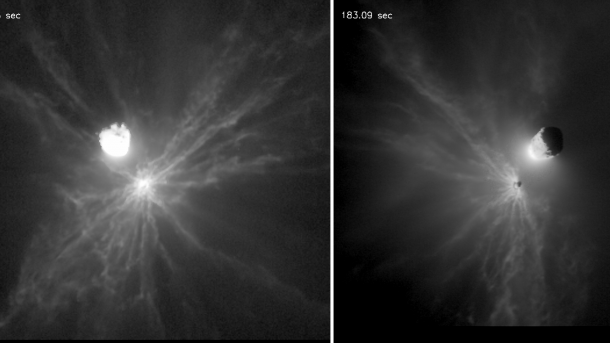
(Image: NASA DART team and LICIACube)
When NASA's Dart spacecraft crashed into the asteroid Dimorphos, a surprising amount of debris was thrown in unexpected directions. This was discovered by a research team led by astronomer Tony Farnham from the University of Maryland, who believes that this could complicate future asteroid defense plans. As the research group explains, although the impact of the probe deflected the asteroid, the chunks of rock that were knocked out in the process would have given it an almost equally large further push. This additional factor changes the physics involved here and must be considered when planning future missions.
Uncontrolled movement possible
For the analysis, the research group evaluated images of the impact taken on site by the Italian space probe LICIACube. They counted 104 pieces of rock with radii between 0.2 and 3.6 meters. Some of them were hurled away at almost 190 km/h. However, this did not happen randomly in all directions; instead, the debris was traveling in two groups. Something unknown was responsible for this, explains Farnham. His team speculates that the probe hit two large chunks of debris during its impact. The debris flew away perpendicular to the probe and could have caused the asteroid to start tumbling uncontrollably.
Videos by heise
As the impact served as a test run for an asteroid defense system, the finding is significant. If a dangerous celestial body were to actually hurtle towards us and we had to deflect it in a very specific way to prevent it, such small details would be of great importance, says Farnham. Think of it like a cosmic game of pool: “If we don't calculate all the variables, we could miss.” The research work has now been published in the Planetary Science Journal, and the team and many other researchers are waiting for an ESA probe to check on site what Dimorphos looks like now.
Dart (Double Asteroid Redirection Test) crashed into the asteroid moon Dimorphos at 01:14 CEST on September 27, 2022. The collision was the first time that mankind has deliberately altered the movement of a celestial body. The hope is that an asteroid dangerous to Earth could be deflected by such an impact to such an extent that it misses our home planet. Because the probe was destroyed in the impact, the ESA launched the Hera mission last fall. It is intended to investigate the effects of the impact on site and should then also find out exactly what consequences the uncontrollably ejected boulders had on the asteroid's orbit.



(mho)

