


Robot dog climbs vertical walls using "chimney climbing" technique
Using "chimney climbing," the robot dog Kleiyn moves upward between two walls. It does this 50 times faster than the previous record holder.
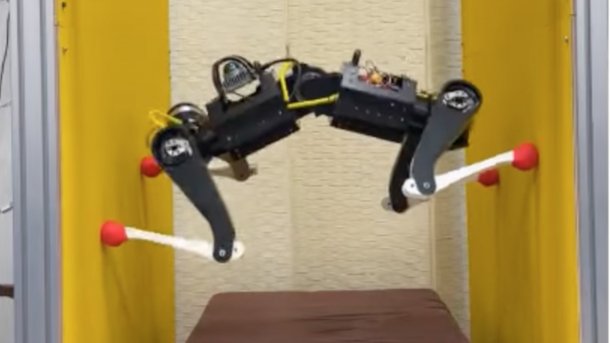
The robot dog Kleiyn has a flexible back, enabling it to climb upwards between two vertical walls.
(Image: Screenshot/JSK Tendon Group/Kento Kawaharazuko)
A team of scientists at the Jouhou System Kougaka Laboratory (JSK) at the University of Tokyo has developed a four-legged robot called Kleiyn that can climb two opposite vertical walls using a “chimney climbing” technique with only its legs and feet. Unlike conventional four-legged robots, the robot dog has a joint in the middle of its back to perform this feat.
The four-legged robot dog Kleiyn is 76 cm long and weighs around 18 kg. It has 13 joints. One of these is located in the middle of its back, as the researchers write in the study “KLEIYN: A Quadruped Robot with an Active Waist for Both Locomotion and Wall Climbing,” which has been published in preprint on Arxiv. The joint allows the robot to bend its back to climb two opposite walls using the “chimney climbing” technique.
The scientists use this technique to avoid having to use claw-like feet, which would provide better grip but make it difficult for the robot dog to walk. To climb, the robot positions itself between two parallel vertical walls that it must be able to reach with its feet. The robot dog places its feet between the walls and supports itself between them. By relieving and pushing through its back and legs, it moves step by step up the walls.
Empfohlener redaktioneller Inhalt
Mit Ihrer Zustimmung wird hier ein externes YouTube-Video (Google Ireland Limited) geladen.
Ich bin damit einverstanden, dass mir externe Inhalte angezeigt werden. Damit können personenbezogene Daten an Drittplattformen (Google Ireland Limited) übermittelt werden. Mehr dazu in unserer Datenschutzerklärung.
According to the scientists, the robot achieves a climbing speed of 0.15 to 0.17 meters per second. This requires that the walls are between 0.8 and 1 m apart. At greater widths, the torque limitations of the motors cause problems. Nevertheless, Kleiyn is probably the fastest climbing robot of its kind. The previous record holder, the six-legged robot SiLVIA from the Robotics & Mechanisms Laboratory (RoMeLa), moves at about one-fiftieth of the speed.
Learning to climb through reinforcement learning
The robot first learned the necessary movements in a simulation using reinforcement learning (RL). Using a special training method called Contact Guides Curriculum Learning (CGCL), Kleiyn was taught to master the transition gradually between flat ground and vertical surfaces. The training system used, Asymmetric Actor-Critic RL, enables the robot to learn from simulation data that only considers basic sensors from real-world applications.
Videos by heise
However, the robot dog still has some room for improvement. For example, it moves sideways when climbing. The researchers suspect that better environment recognition, for example, using lidar, is necessary to solve this problem. In addition, the direct drive motors used heat up during longer climbing sessions. The researchers want to correct this by improving load distribution.



(olb)

