


ESA develops hydrogen hypersonic aircraft with Mach 5
The ESA has set itself ambitious goals: a hydrogen-powered hypersonic aircraft that can take off horizontally and ascend to Earth orbit.
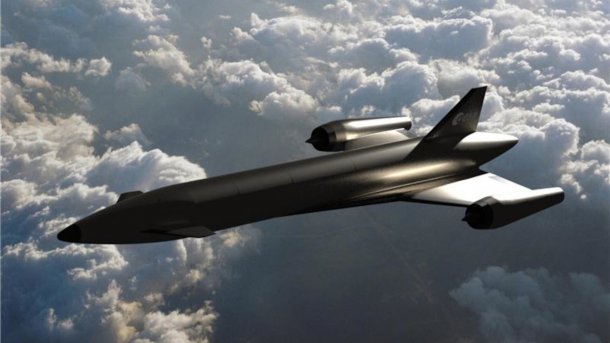
ESA's hypersonic aircraft could look something like this.
(Image: Frazer-Nash)
The European Space Agency ESA has launched the Invictus program to develop a hypersonic aircraft. This was announced by the ESA on Wednesday. The air vehicle, which is to be designed as a full-scale test aircraft, should be able to reach speeds of up to Mach 5 (approx. 6125.2 km/h) and be fully reusable. The plan is for the hydrogen-powered aircraft to take off like an airplane and then reach an orbit around the earth like a rocket.
ESA wants to develop the hypersonic aircraft together with the British engineering and technology company Frazer-Nash as part of the Invictus program. The consortium will also include other companies and universities, such as the aircraft fuselage specialist Spirit Aero Systems and Cranfield University. Even the first step sounds ambitious: Together, the partners are to deliver a preliminary design of all the hypersonic aircraft's systems within 12 months.
The money required for this is to come from the General Support Technology Program (GSTP) and the ESA's Technology Development Element (TDE). ESA is not revealing the estimated sums involved.
Solving the heat problem
In its press release, ESA explains the problems that can be expected in the development of a hypersonic aircraft. In particular, the extreme heat generated by the surface friction of the aircraft's outer shell and the shock heating caused by the high speeds must be contained.
Empfohlener redaktioneller Inhalt
Mit Ihrer Zustimmung wird hier ein externer Inhalt geladen.
Ich bin damit einverstanden, dass mir externe Inhalte angezeigt werden. Damit können personenbezogene Daten an Drittplattformen übermittelt werden. Mehr dazu in unserer Datenschutzerklärung.
The developers are therefore planning to use a hydrogen-powered, pre-cooled air-breathing propulsion system, which should enable the aircraft to reach the targeted 5 times the speed of sound. At the same time, the thermal issues should also be brought under control. The propulsion system should be suitable for horizontal ascent and hypersonic flight.
The planned pre-cooling system is based on the ESA's SABRE study (Synergistic Air-Breathing Rocket Engine). The study discussed the construction of a precooled engine to create horizontal take-off spacecraft. The British engine manufacturer Reaction Engines has already successfully developed such a system and used it to cool conventional jet engines. This was also funded by the GSTP. The technology makes it possible to cool the extremely hot air of the engines within fractions of a second.
Videos by heise
The hypersonic aircraft equipped with such a propulsion system could make ESA's vision of developing a horizontal take-off spacecraft a reality. The hypersonic aircraft is also intended to be used as a research object. So far, China has taken the lead in the field of hypersonic aircraft technology and is already testing drones that can fly at several times the speed of sound. China also has an advantage in the field of military hypersonic missiles. The development of a European hypersonic aircraft could possibly help to break China's superiority in hypersonic technology.



(olb)

