


Meta's new VR prototypes explore the limits of technology
In August, Meta is expected to present three new headset prototypes that can compete with the human eye in terms of field of vision and pixel density.
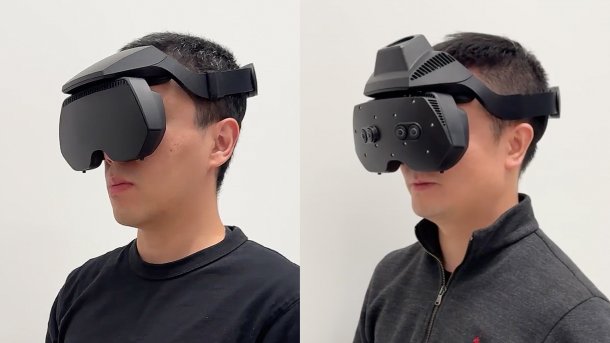
Meta's prototypes combine a horizontal field of view of 180 degrees with a compact form factor
(Image: Meta Reality Labs Research)
In the run-up to the SIGGRAPH computer graphics conference, researchers from Meta Reality Labs Research have announced the presentation of three new headset prototypes and published initial details about the devices.
The first two prototypes offer a horizontal field of view of around 180 degrees. This is a significant leap compared to commercially available VR glasses such as Apple Vision Pro and Meta Quest 3, which achieve a field of view of 100 and 110 degrees respectively.

(Image: Meta Reality Labs Research)
It is worth noting that Meta achieves the wide field of vision in a relatively compact housing, comparable to the headsets mentioned above. Other VR systems with a similarly wide field of vision are generally much bulkier and designed for industrial and simulation-related applications.
The first of these two prototypes is designed exclusively for virtual reality, while the second supports passthrough and is therefore suitable for mixed reality applications. Special cameras with 80 megapixels at 60 frames per second are used. For comparison: Meta Quest 3 uses cameras with 4 megapixels for passthrough, while Apple Vision Pro uses around 6.5 megapixels. Meta's MR prototype should therefore also set new standards in terms of pass-through sharpness.
Both headsets use a special optical system with highly curved polarizers to enable a wide field of view in a compact design.
Videos by heise
Third prototype with extremely high pixel density
Meta's third headset prototype, of which no image material is yet available, pushes the boundaries in terms of pixel density.
Pixel density is measured in PPD ("pixels per degree"), i.e. the number of pixels that are displayed on a single degree of the horizontal field of view. In the VR industry, a PPD value of 60 is considered the threshold for "retina resolution", i.e. the point at which the human eye can no longer perceive individual pixels. However, human vision is actually much more powerful: under optimal conditions, differences of up to 120 PPD can be recognized.
Commercially available devices such as the Meta Quest 3 and the Apple Vision Pro are still well below Retina resolution at 25 and 34 PPD respectively. Meta's new prototype, on the other hand, achieves 90 PPD, a new peak value, even if it is not yet clear how large its field of view will be. An earlier prototype called Butterscotch achieved 55 PPD with a field of view half the size of the Quest 2. In the commercial sector, Varjo's industrial headsets of the XR-4 series offer a comparable pixel density of 51 PPD.

(Image: Pimax)
The display of the third prototype is also characterized by a high brightness of 1,400 nits, about fourteen times as much as the Meta Quest 3 and the Apple Vision Pro.
More details are expected to be available at SIGGRAPH 2025, where Reality Labs Research will present and exhibit the devices. At least that's what the published abstracts Wide Field-of-View Mixed Reality and Hyperrealistic VR say.
However, commercial products of this kind should not be expected, at least not any time soon. Meta refers to such prototypes as "time machines", which are intended to show how certain technical features affect the user experience in maximum expansion. The knowledge gained is then used for further research and development without directly resulting in products.


(tobe)


