


DLR and Bundeswehr to exchange almost all space data in future
German space agency and the Bundeswehr will exchange data at the Space Situational Awareness Center. This should contribute to better infrastructure protection.
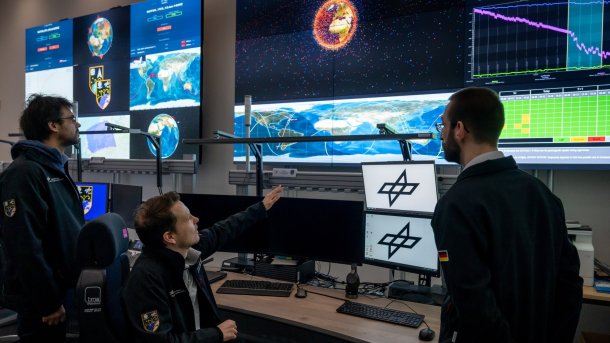
The space situation center in Uedem
(Image: Bundeswehr/Jennifer Heyn)
The German Space Agency at the German Aerospace Center (DLR) and the German Armed Forces Space Command have been operating the Space Situational Awareness Center in Uedem on the Lower Rhine together since 2011. However, although both institutions work closely together to identify potential threats in and from space, there have been legal hurdles to joint information processing to date. To overcome these, both parties concluded a joint use agreement on Tuesday. On this basis, the mutual, almost complete exchange of data should be possible from now on.
In the center, employees of the space agency and the space command of the armed forces jointly create a situation picture of the current situation in space. On this basis, they offer various services for different users within and outside the German government. This includes, for example, the direct protection of its space infrastructure by assessing critical approaches by other objects.
The duo also provides information to authorities and Bundeswehr task forces about the situation and influences from space. At the same time, the center keeps civil protection constantly up to date to inform the population about the associated dangers in the event of the re-entry of dangerous space debris or other objects. The Bundeswehr is also aiming for “comprehensive” space surveillance via a remote observation system installed in Meßstetten.
More and more satellites, more and more space debris
The agreement that has now been signed is intended to provide the operating personnel in Uedem with more security in the cooperative use of data and put this on a clear legal basis. DLR also expects this to “significantly increase safety in space”. The agreement is “a further step towards intensifying joint efforts” at the center.
The background to this is that the number of actively used satellites – is at a record level, not least due to massive constellations for broadband internet such as Starlink or Kuiper, and space debris is also increasing significantly as a result. According to DLR, the latter now comprises over 10,000 tons of material. Most of it is in low orbits at altitudes of up to 2000 kilometers. Most active satellites are also located in this Low Earth Orbit (LEO). The risk of collisions is therefore particularly high there.
Videos by heise
To take countermeasures, continuous reliable data on the space situation is required, which is provided by systems such as the German Experimental Surveillance and Tracking Radar (Gestra). This device for observing and tracking objects in space was manufactured by the Fraunhofer Institute for High-Frequency Physics and Radar Techniques (FHR) and financed by the DLR with federal funds. The mobile system with 256 individual antennas, which is funded by the Federal Ministry of Defense, is currently being operated at the Space Center. In a declaration recently adopted at the UN Summit for the Future, experts stated that LEO threatens to become useless if companies and countries do not cooperate. They would have to share the data “needed to manage this most accessible space region.”


(mma)


