


40 years of Amiga – the wow machine
The Commodore Amiga 1000 not only marked the beginning of the multimedia age in 1985. The architecture and its effects are still significant today.
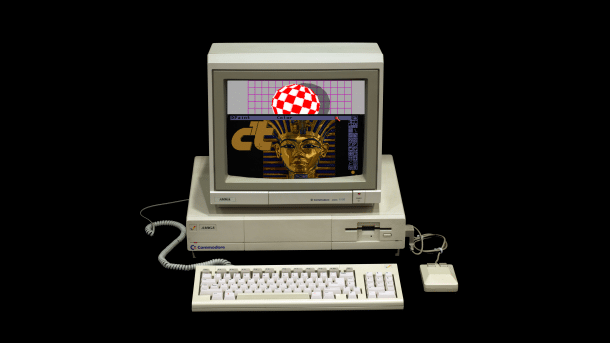
Amiga 1000 – The pixel painting program Deluxe Paint can be seen on the screen in the foreground. At the same time, the Boing ball - the original demo and the Amiga's distinguishing mark - is bouncing in the background.
(Image: CC BY-SA 2.0 fr, Rama/Bearbeitung: heise online)
This is part one of a three-part series about the Amiga. The next parts will be published in the next two days.
Wow – that was the regular reaction from July 23, 1985 onwards when someone saw an Amiga in action. Animated color graphics, stereo sound and a multitasking operating system were astonishing, because no home computer of the time could do anything comparable. Not even the Apple Macintosh, which had appeared a year earlier and looked completely different with its integrated black and white monitor. "The Amiga", presented 40 years ago today at a pompous event in New York, looked like a high-end workstation – but cost only a fraction of these machines. Compared to the C64, for which Commodore charged 149 US dollars at the time, the 1295 US dollars initially charged was more of an "oops" than a "wow".
It is often claimed that it was the price in particular that prevented the computer, which was renamed "Amiga 1000" shortly afterwards, from taking the entire computer world by storm. Because it didn't, otherwise there would probably be Amigas on or under desks today, and not PCs or Macs. However, the main reason for the slow start is undoubtedly Commodore. The company, which finally went bankrupt in 1994, had already lost its way in 1985: The less successful C128 hit the stores at the same time as the Amiga, and Commodore was only able to deliver the wow machine in larger quantities just before Christmas. In addition, there was hardly any advertising – and the company had debts in the hundreds of millions.
Boom only two years later
The Amiga only became really successful from 1987, when the Amiga 500 appeared as a keyboard computer in the classic design of home computers. The Amiga 2000, with its huge sheet metal housing designed for expansion at Commodore Germany in Braunschweig, was intended to serve the professional market. The prices: 699 US dollars for the 500, and 1495 for the 2000. Apart from a standard expansion to 512 KByte RAM, both machines had no performance advantage over the Amiga 1000. Commodore had therefore lost two years with a sensible positioning as both a home computer and a workstation, while the Atari ST, which also appeared in 1985, was already competing strongly with several models.
The fact that the three Amigas were still able to create a lot of "wow" by the end of the 1980s was due to their pioneering architecture for the time. We have already described in detail how the machine, which was originally planned as a uniquely powerful games console, came about. So here is a brief overview of the innards, which are largely identical in terms of function and components in the Amiga 500, 1000 and 2000. At its heart is the 68000 processor from Motorola, which Amiga inventor Jay Miner wanted to use to build a computer years before his computer was introduced. To understand why the Amiga technically dominated the late 1980s as a gaming and creative machine, it is necessary to take a look at the chips.
A 16/32-bit CPU and three custom chips
The 68000, also the engine of the Macintosh and Atari ST, is essentially a 32-bit CISC CPU, with correspondingly wide registers, but only a 16-bit wide data bus and a 16-bit wide arithmetic unit (ALU). It lacks a floating point unit (FPU), which could be retrofitted as a separate component in later versions from the 68020 onwards or was integrated straight away. The overall package of the first 68000 was therefore full of compromises, but offered two major advantages: Low price and simple – and therefore equally cheap – connection of additional chips through the narrow external buses. Central to the Amiga is the self-developed "Agnus", which is connected to the data and address bus of the 68000.

(Image: Commodore)
This means that the other custom chips can handle their functions for input and output, sound and graphics via Direct Memory Access (DMA) with minimal intervention from the processor itself. Agnus is, among other things, a DMA controller for the entire system. This is roughly comparable to today's PCI Express root complex, which is integrated in modern x86 CPUs, and on whose bus subsystems for network, graphics, sound, data carriers and I/O hang.
Agnus rules over Denise and Paula
The Amiga chips that set it apart from the Mac and ST are certainly not nearly as complex as today's graphics cards, which come with their own firmware and RAM. But they offered a multitude of functions that are already in their names. It is certainly no coincidence that they have female names, analogous to the Spanish "Amiga", meaning girlfriend. However, the names also describe the functions.
– Agnus (address generator): Communication of the special chips with the main processor, memory management for chip RAM, video synchronization and DMA. Agnus also had the Blitter (block image transfer) and Copper (co-processor) coprocessors integrated.
– Denise (Display Encoder) Graphics output, sprites, blitter objects (bobs)
- Paula (Peripherial/Audio) Four-channel digital sound, serial interface, drive control
With Amiga 500 and 2000, Gary (Gate Array) was added, which integrated some functions previously implemented in standard components into one chip. The first three custom chips represent the "Original Chipset" (OCS), later came the "Enhanced Chipset" (ECS) and the "Advanced Graphics Architecture" (AGA). But only three chip generations in nine years, i.e. from 1985 to Commodore's end in 1994, were simply far too few for the rapid pace of development in computer technology at that time.
A special feature of the Amiga architecture is the division into chip and fast RAM. In order to achieve the graphics and sound possibilities via DMA, Agnus is responsible for the chip RAM, which was only 256 KByte in the Amiga 1000 and up to 2 MByte in later models. However, without dedicated graphics cards, this also limited further development. The Fast RAM is controlled by the memory controller of the 68000 CPU and is easily expandable via its buses. It is therefore faster, especially when an Amiga is expanded with a 68020 or later 68k CPUs. Motorola continued the series up to the 68060, which could almost have competed with Intel's Pentium in 1994 with modern functions such as superscalarity and jump prediction. However, the PC and Windows had long since won the market leadership.


