


Working 24/7: Walker S2 robot replaces its own batteries
The humanoid UBTech Walker S2 should be able to work as continuously as possible. To achieve this, it can replace its batteries independently.
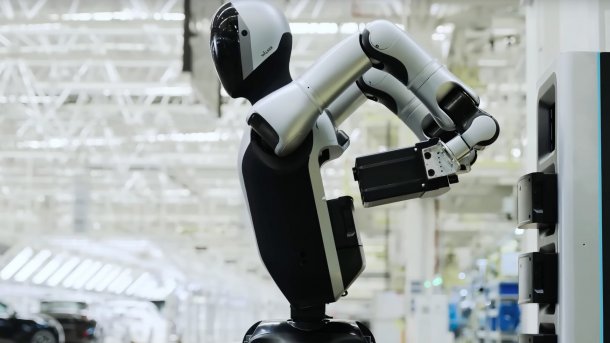
(Image: Screenshot/UBTech Robotics)
The Chinese robotics company UBTech Robotics has taught its humanoid robot Walker S2 to change its own batteries during operation. In principle, this means that the robot can be continuously supplied with power and, in the best-case scenario, can work 24/7.
The humanoid Walker S2 is around 1.62 m tall and weighs 43 kg. Two 48-volt lithium batteries provide the necessary energy supply. The batteries are designed as a dual battery system so that one of the batteries can be replaced during operation. One battery provides energy for two hours of walking or around four hours of standing work.
Empfohlener redaktioneller Inhalt
Mit Ihrer Zustimmung wird hier ein externes YouTube-Video (Google Ireland Limited) geladen.
Ich bin damit einverstanden, dass mir externe Inhalte angezeigt werden. Damit können personenbezogene Daten an Drittplattformen (Google Ireland Limited) übermittelt werden. Mehr dazu in unserer Datenschutzerklärung.
However, charging the battery is a problem. It takes up to 90 minutes to recharge to full power. Too long for the robot to leave its work to hang out at a charging station.
However, the UBTech engineers have found a solution: They pre-charge batteries for the robot so that it can pick them up from the charging rack on its own and replace them on its own. To do this, the Walker S2 grabs its empty battery with its movable arms, takes it out of its back and positions it in the charging station. It then places the charged battery on itself.
Videos by heise
According to UBTech, this makes the Walker S2 the first humanoid robot capable of replacing its own battery autonomously. Previously, this required a human operator to remove, charge and reinsert the battery.
Working around the clock
UBTech promises that the Walker S2 will independently recognize when its battery is running low and when it needs to be replaced in order to continue carrying out certain tasks. This should enable the robot to last longer and work completely autonomously. The aim is for such humanoid robots to be able to be used around the clock in production or services.



(olb)

