


NASA astronaut on ISS controls robot in German "Mars" environment
Robots can represent astronauts as avatars on Mars. A simulated experiment by NASA and DLR should show whether this can work.
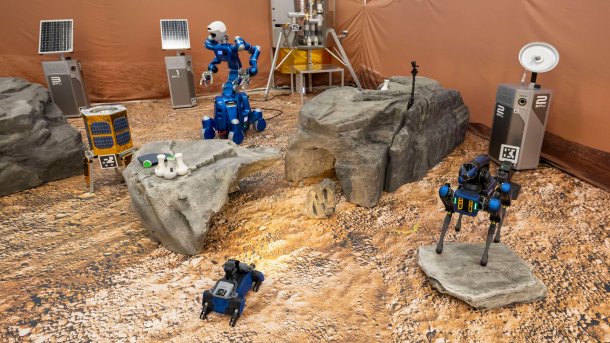
(Image: DLR (CC BY-NC-ND 3.0))
NASA astronaut Jonny Kim has piloted a team of robots from the International Space Station (ISS) in a simulated Martian environment at the German Aerospace Center (DLR) in Oberpfaffenhofen. This was announced by DLR on Thursday. During the experiment as part of the "Surface Avatar" mission, the "injured" robot dog Bert was also treated. During the tests, the AI chatbot assistant "NealAI" was also used to assist astronauts with questions.
The US space agency NASA and DLR used four robots for the test mission: the semi-humanoid DRL robot Rollin' Justin, the ESA rover Interact and the two four-legged robot dogs Bert from DLR and a Spot robot from ESA. The task was to explore the simulated Martian landscape, collect rock samples and test the control of the robots by a human who had not received any intensive training in advance. The European Space Agency (ESA) and the German Space Operations Center (GSOC) were also involved in the experiments.
Empfohlener redaktioneller Inhalt
Mit Ihrer Zustimmung wird hier ein externes YouTube-Video (Google Ireland Limited) geladen.
Ich bin damit einverstanden, dass mir externe Inhalte angezeigt werden. Damit können personenbezogene Daten an Drittplattformen (Google Ireland Limited) übermittelt werden. Mehr dazu in unserer Datenschutzerklärung.
Kim issued commands to the robots from the ISS to carry out various tasks. For example, he instructed Bert to locate distributed sample containers, pick them up with its gripper arm and bring them to a transfer point. Rollin' Justin then brought the containers to the landing vehicle as instructed. The robots were thus able to collect several Martian samples and deposit them in the lander for possible transportation back to Earth. The robots did this autonomously. The astronaut simply gives the appropriate instructions and can then move on to other tasks.
Getting "injured" Bert afloat
Another mission simulated the transportation and failure of a robot. The Interact rover transported robot Bert to a cave for exploratory tasks. There it was released with a gripper arm on Kim's instructions. However, Bert had an intentional malfunction that immobilized one of its legs, preventing it from carrying out the planned exploration. Kim then instructed the robot to try different gaits to find a stable gait that would allow it to walk on only three legs. Through the use of reinforcement learning, Bert was able to walk in a way that allowed him to begin his exploration mission. Steering through the cave was done manually by the astronaut using the robot's cameras for vision.
Videos by heise
Kim carried out further explorations in the simulated Martian landscape with the robots, using them as his avatars to feel the environment and receive physical feedback. Rollin' Justin has a force feedback function for this purpose.
Kim used the AI chatbot assistant NealAI to prepare for the mission. The chatbot can answer questions about the functions of the robots, their controls and the user interface of the control unit. In a real Mars mission, the communication breaks of up to 40 minutes between the control center and the robotic exploration team could be used to clarify any questions.



(olb)

